Saturday, October 20, 2012

Eastern Red-spotted Newt, From Red Eft to Salamander

Can you spot the red eft in this picture?
Click for a larger version.
Photo by Brad Sylvester, copyright 2012
One of my favorite three-letter Scrabble words is "eft." An eft, more specifically a red eft, is the juvenile form of the Eastern red-spotted newt (notophthalmus viridescens).

Newts and Salamanders

The red eft is commonly called a newt, but where I grew up, the adult form is called a salamander. It looks and acts very different once it reaches the adult stage, so many don't realize that they are, in fact, the same creature.

A closer view shows how the red eft's coloring
blends in with the browns, yellows and oranges
of the forest floor in addition to advertising
its toxic nature.
Photo by Brad Sylvester, copyright 2012.
The juvenile Eastern red-spotted newt lives on the forest floor away from bodies of water, though it does prefer a moist environment. The adult is aquatic, and while it may occasionally climb out of the water onto the shore of a piece of driftwood, it lives, eats, and lays its eggs in the water.

They are also quite different in coloration and somewhat different in body shape. The juvenile red eft form is bright orange. It has small red spots outlined in black on its back and its belly is a lighter yellow-orange. The adult retains the red spots, but is a dark olive green that blends in well with mud. The underbelly of the adult tends toward yellow. Both have scattered, small black spots, like flakes of pepper on their sides and bellies.

The adults have tails better equipped for swimming. Unlike the juveniles', the adults' tail grows a thin ridge on the top and bottom to give it more surface area with which to push against the water as it swims.

Adult Eastern red-spotted newts prefer slow-moving bodies of water. They are most often found in still ponds or the shallow back-waters of larger lakes. They drift lazily at the surface or dive down to the bottom to forage in the muck. They are relatively easy to catch with a minnow net or even bare hands.

Despite the toxins in their skin, the Eastern
red-spotted newt can be safely handled.
Photo by Brad Sylvester, copyright 2012.
The orange juveniles are usually spotted walking along the forest floor, especially after a rain when the leaf litter is damp. Red efts may live on land for as many as three years before returning to the water as adults, according to the New Hampshire Fish and Game Department. They also note that both the juveniles and the adults are poisonous, secreting toxins in their skin to dissuade predation. Despite this, they are completely harmless to humans and can be carefully handled (though not eaten) without fear.

Quick facts about the Eastern red-spotted newt:

Classification: The Eastern red-spotted Newt is an amphibian like all salamanders, and not a reptile like lizards.

Diet: The Eastern red-spotted newt is generally carnivorous, eating insects, small smalls, worms, and the eggs of frogs and fish. NHPTV says that the red eft especially dines on springtails.

Where does the Eastern red-spotted newt go in the winter? The adults can survive and remain active all winter long under the ice. The land-based juveniles hibernate under rocks or logs.

Life cycle: Adults lay eggs which are individually attached to underwater vegetation although a female may lay as many as 400 in a single season. The eggs hatch into a larval form, like a frog's tadpole. The larva develops into the red eft and leaves the water for a period of 1-3 years before maturing into an aquatic adult. (Note that the IUCN data page says that red efts may persist in the juvenile stage for as long as seven years, but most sources list 1-4 years as typical. It seems counter-intuitive to me, that they would spend seven years as juveniles with an overall natural lifespan of 5-15 years. Perhaps, in rare cases where persistent drought or lack of food stunts their development or prevents them from finding a resident body of water, but under ordinary conditions, I'm not convinced of the seven year figure.)

Lifespan: Eastern red-backed newts can live up to 15 years according to the Connecticut Wildlife website.

IUCN Red List Status: The IUCN lists the Eastern red-spotted newt as a species of least concern due to large numbers and widespread habitat.

Taxonomy of the Eastern red-spotted Newt:

Kingdom: Animalia
Class: Chordata
Phylum: Amphibia
Order: Caudata
Family: Salamandridae
Genus: Notophthalmus
Species: Notophthalmus viridescens


Thursday, June 28, 2012

Using Light Traps to Catch Insects

A simple insect light trap can be
constructed using these four components.
Photo by Brad Sylvester, copyright 2012
Up until now, for the most part, I have been simply recording the creatures that live in my yard as I find them, one by one. Sometimes, I go out looking for them, and I did use small insect pit traps to collect a couple samples. There's another way, however, to find some creatures that I would otherwise not be able to locate and to collect much larger numbers of species all at once.

What is a Light Trap?

That method involves using light traps. Light traps rely on the fact that many nocturnal insects are strongly attracted to light. By setting up lights to shine on white surfaces, we can induce large numbers of such insects to land on those surfaces. If the surface is slick and slanted sharply, many of them will fall to it's base where a collection bin of some kind can hold them until they can be gathered and examined. The sooner they can be collected, the better.

Many entomologists will line the bottom of the collection bin with poison that kills the collected insects quickly, before the specimens can be damaged by each other, or by struggling to escape. I'm not going to do that. Instead, I'll try to use a collection bin that minimizes such damage. One of the difficulties with live collection bins is catching live insects from the collection bin, without them either escaping once it is opened, or damaged by the collector when they are removed.

Limitations of Light Traps

These kinds of traps can not and will not catch every insect that hits the illuminated collection surface, and certainly not every species of insect in a given area. Some, if not most, will either rebound off the surface and miss the collection bin, or take flight again without falling into the bin. Some will be able to land on the collection surface and remain there due to their adhesion to smooth surfaces being stronger than gravity. Many other insects are not attracted to light at all and will be found in a light trap only by rare coincidence, if at all.

So, the absence of any particular species in a light trap does not mean it isn't there, just that it wasn't caught. Light traps do, however, provide a means of large scale species sampling of a location, and in some cases, can capture hundreds of species of insects in a single night.

The species that are caught by any given light trap will depend upon where it is placed. One placed in an open field, for example, will catch different species than one just 50 yards away in a thicket. There will, generally, be some overlapping species, but many will only be found in one habitat or the other.

I'm going to start with one light trap, placed in the woods. My time and ability to process large numbers of insects for this blog are limited, so I'll use a smaller light collection surface, and I may turn the lights out fairly early in the evening if the trap has accumulated a significant number of species. In any case, I'll post again tomorrow with an overview of the results and then I'll begin adding new species pages as quickly as I can.

How to Build a Simple Light Trap

Equipment:
1 collection sheet (A flexible sheet of white material, smooth plastic works best.)
1 collection bin, (may be almost anything with smooth vertical walls, a jar, for example)
duct tape
1 light source (This may be turned on for hours so use rechargeable batteries or an approved outdoor extension cord)

Figure 1: A small hole leads into the collection
bin. The hole is at least several inches above
the bottom of the collection bin.
Photo by Brad Sylvester, copyright 2012
Step 1:
Curl the plastic so that it forms a small opening inside the collection bin, and the sides conform to the shape of the collection bin. Use a piece of duct tape to hold the collection sheet together, as shown in figure 1.

Step 2:
Use duct tape to pull the plastic collection sheet tight ot the edges of the collection bin so that no openings remain except the one inside the curled collection sheet.

Step 3:
Figure 3: Simple, home-made light
trap for catching insects at night.
Photo by Brad Sylvester,
copyright 2012
Lean the back edge of the collection sheet against a tree or other support, so that it will not fall down in the wind. Place the flashlight so that it shines onto the fron of the collection sheet as shown in figure 2.

Collecting Insects with the Light Trap

Once the collection bin has many insects inside, you can shake the collection sheet to drop any insects still haning on into the collection bin. Then, remove the collection sheet and quickly cover the collection bin.

Converting the Light Trap Collection Bin into a Killing Jar

The collection bin will have a number of insects of unknown species. If you are unsure of the safety of handling the inssects you have caught, or have any allergies to stings or bites, you may wish to convert the collection bin into a killing jar so that the insects are dead before you attempt to handle them. This can be accomplished by using tweezers to dip a cotton ball into nail polish remover and then placing the cotton ball inside a smaller container inside the collection bin. Cover the collection jar or bin immediately.

Depending upon the size of your collection bin, you may need to use several nail polish soaked cotton balls to achieve a concentration of fumes sufficient to kill the insect inside. Allow several minutes for the fumes to take effect. Be sure to avoid inhaling the fumes yourself and follow all safety warnings from the manufacturer of the nail polish remover.

Monday, June 25, 2012

Appreciating the Journey

With just 43 species identified from the hundreds or thousands that live in my yard, already I am able to take the knowledge I've gained by taking the time to learn about these creatures and apply it as I walk through my yard.

Instead of just walking past and thinking what a beautiful dragonfly and wondering what kind it is, whether it bites or stings. I know what species it is and I think: What a beautiful adult male Twelve-Spotted Skimmer. Looks like it's out hunting for flies. It must have hatched last fall down in the wetlands at the base of the valley. Most likely, it will return there to breed as well. I know how to hold it carefully in my hand for closer examination without harm to either it or myself.

Or I can hear a birdsong and know that the sudden stop to the whip-poor-will's song will probably only last 10 or 15 seconds as it moves to another spot around the perimeter of its territory and resumes singing. I know what nights it is more likely to sing and what time of the night I might expect to hear it. I know where it nests and how it feeds.

All of that is really the reason that I started this blog and this project in the first place. I wanted to understand more about the world in which I live. I wanted to know how the creatures that live in my yard interact with one another and how my presence here affects them. I wanted to know what I can do to make sure they stay and thrive here and to make sure that I don't do anything that inadvertently renders this habitat unsuitable for them.

I may not ever be as knowledgeable as some of the experts I have met over the last few years, but I certainly know much more than I did, and I'm learning more every day. I know who my animal neighbors are and how they're doing by watching their behavior and the state of the "neighborhood" in which we all live. I am not just leaving a footprint on this five acres of land, but becoming a part of it and the community that owned it long before I did.


Tuesday, June 12, 2012

Northern Pink-striped Oakworm Moth


Northern Pink-striped Oakworm Moth, male
Photo by Brad Sylvester, copyright 2012.
Do not copy.
Some days I go out into my yard looking for a new species to chronicle in this blog. On other days, I just happen to run across interesting species serendipitously. On June 8th, I was out building a new shed when my son called me over to look at a moth that he found sitting on a piece of plywood we had lying on the lawn. It turned out to be a Northern Pink-striped Oakworm Moth (Anisota virginiensis virginiensis).

Moth or Butterfly?

It was one of the most colorful moths I had ever seen. Remember the checklist of butterfly versus moth traits I used to help identify the skippers (Hesperidae Family) last July? This one is not nearly as tricky as the skippers.

Northern Pink-striped Oakworm Moth
(Anisota virginiensis virginiensis)
Photo by Brad Sylvester, copyright 2012
Do not copy.
It has broad, feathered antennae, a large head, a thick, hairy body, and holds it wings flat and swept back while at rest. The bright colors and the fact that it was out and about during the daytime are the only traits which might suggest butterfly, but the others are far more accurate indicators. So we can be sure that it is a moth.

There are many, many species of moths and I certainly don't know them all or even a large percentage by sight. This one was knew to me, but was reminiscent of the Rosy Maple Moth. The Rosy Maple Moth is member of the taxonomic Family Saturniidae (Saturn Moths or Giant Silkworms and Royal Moths). Therefore, I started looking for a match at the Family level.

In reviewing images of the Rosy Maple Moth, I saw several photos of its larval form at bugguide.net and in my Audubon Field Guide. I recalled having seen a very similar early instar caterpillar on some oak leaves very near where this caterpillar was found. Perhaps then, instead of a Maple Moth it was some kind of Oak Moth. Using the search term "Oak Moth Saturnidae," I was able to find the Pink-striped Oakworm Moth (Anisota virginiensis), which has three sub-species.

Sub-species of Anisota virginiensis

The sub-species are most easily differentiated by the regions in which they live. In New Hampshire, we'd expect to find the sub-species Northern Pink-striped Oakworm Moth (Anisota virginiensis virginiensis). The Southern Pink-striped Oakworm Moth (Anisota virginiensis pellucida) lives from South Carolina to Florida and west to Louisiana according to Bugguide.net. While the Texas Pink-striped Oakworm Moth (Anisota virginiensis discolor) is found, as you may have guessed, in Texas.

Sexual Dimorphism

We know the species, and because the species, like human beings, is sexually dimorphic (the males and females look different), we can tell that the specimen I found in my yard is a male. Size is a key differentiator. The female is significantly larger than the male, but without one of each sex to compare, and without a tape measure handy, this is difficult to determine.

Hyaline Area

The lower wing edge is clearly
visible through the transparent
window of the hyaline area of
the male's forewing.
Photo by Brad Sylvester,
copyright 2012. Do not copy.
The other key trait used to determine the moth's sex is that males have a large clear "window" on the forewing (the larger wing on each side). You can literally see right through this part of the male's forewing. This is called a hyaline area. The female has no such clear patch.

Starvation Diet

Normally, I'd include dietary information in the Quick Facts section, but this one's pretty interesting. The larva of the species, called simply the pink-striped oakworm, eats oak leaves. If present in large numbers they can do consider damage to a tree's foliage. When they metamorphose into adult moths, however, do not eat at all according to butterfliesandmoths.org. Once they pupate, they begin to slowly starve to death as the stored fats retained from the caterpillar stage are used up.

Diurnal or Nocturnal?

I've already said the specimen of this moth that I found was out during the daylight hours, and I've identified it as a male. Males frequently fly during the day, seeking females by scent. Females, on the other hand, fly at night to find oak leaves suitable for egg-laying and can be attracted by light traps.

Quick Facts about the Northern Pink-striped Oakworm Moth:

Where does it live? Anisota virginiensis virginiensis ranges from Nova Scotia to North Carolina in the East and from Minnesota to Manitoba in the West.

Where does it go in winter? The Northern Pink-striped Oakworm Moth pupates in late fall and overwinters in the pupa just below ground according to butterfliesandmoths.org.

Habitat: Pretty much anywhere that oak trees are found from deciduous forest to city parks.

When is it here? Anisota virginiensis virginiensis does not migrate and is present here all year round. Its flight season, however, runs only from June to July in New Hampshire according to Bugguide, but as one goes farther south there may be two or even three generations each year depending upon how far south one goes. Of course, these are likely the Southern or Texas sub-species.

Lifespan: Up to one year, but perhaps only a few months in warmer climates.

Notes: Eggs are laid in bunches on the underside of oak leaves. According Forestryimages.org, they are spherical and yellow, laid in batches of several dozen at a time. Each egg is individually attached to the leaf.

Date found in my yard: June 8, 2012

Taxonomy of the Northern Pink-Striped Oakworm Moth:

Kingdom: Animalia (Animals)
Phylum: Arthropoda
Class: Insecta (Insects)
Order: Lepidoptera (Butterflies and Moths)
Family:Saturniidae (Silkworm Moths and Royal Moths)
Genus: Anisota
Species: Anisota virginiensis
Sub-species: Anisota virginiensis virginiensis

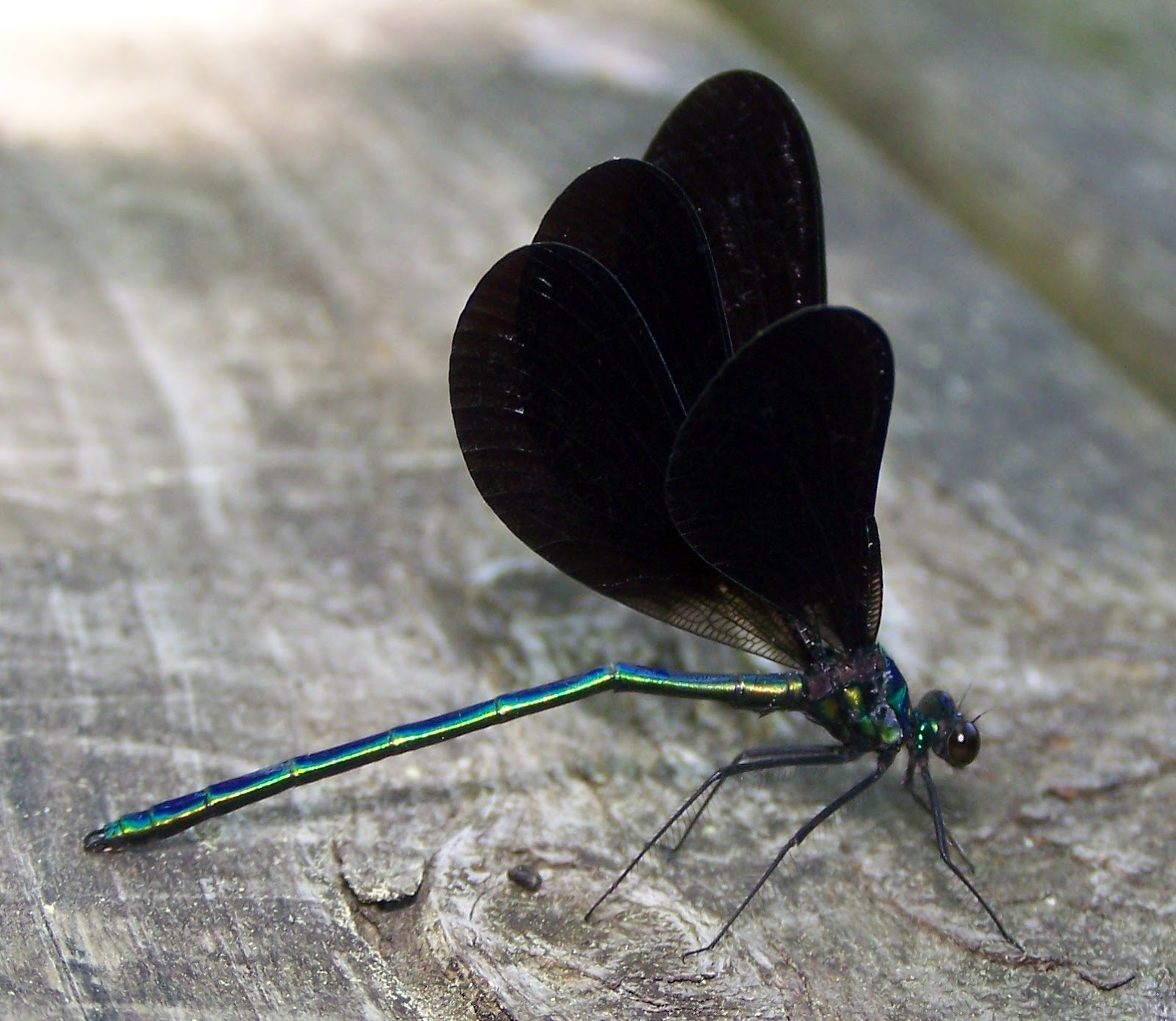
Ebony Jewelwing (Calopteryx maculata): Damsel in Distress

Note that the leading edge of the wings are metallic green like
the body of the ebony jewelwing. This one shows
evidence of injury to its wings, abdomen and legs.
Photo by Brad Sylvester, copyright 2012. Do not copy.
If you're a bug, life is precarious, even if you are a top predator in the insect world. Dragonflies and damselflies, for example, are nature's version of the Predator Drone. These agile and fast flyers criss-cross their hunting grounds looking for other flying insects. When they find one, they grab it out of the air and eat it.

Unfortunately, when you're a bug, there's always something bigger and badder than you. That appears to be the case for the Ebony Jewelwing I found in my yard today. This distinctive damselfly appeared to have seen better days. It was missing a leg, had an unnatural bend in its abdomen, and its rear wings appeared to be skewed to one side.

Of course, you'll remember how to differentiate damselflies and dragonflies from one another, right?
Top view of ebony jewelwing (Calopteryx maculata).
Photo by Brad Sylvester, copyright 2012. Do not copy.
Perhaps it had a near miss with a bird or a larger dragonfly, both of which will eat damselflies like this one. Although still alive and able to stand, its wings seemed incapable of mustering a flight of more than two inches at a time. Granted, ebony jewelwings are not the strongest flyers of the damselfly world, but they can certainly do better than that if not injured. They have a distinctive flight pattern among odonatae. They fly more like butterflies than the high speed, precise flight of most dragonflies and damselflies.

According to Dennis Paulson's field guide "Dragonflies and Damselflies of the East, " ebony jewelwings live along slow-moving forest streams with lots of leafy, green plants around. That is exactly the type of habitat in which I found this specimen. There is a seasonal brook that runs through my back yard along the forest edge. It's banks are covered with ferns, raspberry plants, and other small to mid-sized plants. This is absolutely ideal for the ebony jewelwing. Even so, this is the first specimen I have ever seen in my yard (or anywhere else for that matter.
Identifying the Ebony Jewelwing Species (Calopteryx maculata)
To identify the species of this particular damselfly in New England. The wings are the main clue. This is the only damselfly in this range that has solid black wings. In the Southeast, the smoky rubyspot (Hetaerina titia) also has black wings, but does not have the metallic green-colored body of the ebony jewelwing.

Identifying the Sex and Age of Ebony Jewelwing (Calopteryx maculata)

Ebony Jewelwing caudal appendage detail
Damselflies and Dragonflies can often be precisely identified
and sexed by examining details of the caudal appendage.
Photo by Brad Sylvester, copyright 2012. Do not copy.
The female of this species has a little white dot on the outer wings near the end of the wing at the top. In fact the Latin species name Calopteryx maculata means beautiful spotted wing. This specimen does not have that dot, so we can easily determine that it is a male without a detailed inspection of the caudal appendage. Females would also tend to be less brightly colored through the abdomen. Immature individuals, according to Paulson would have paler wings and the eyes would be a lighter brown color. This leads us to the conclusion that this one is a mature adult.

Of all the odonatae, the ebony jewelwing, in my opinion is the most strikingly beautiful in appearance. I'm hoping the presence of this one in my yard, means that there are more here this year and that they'll be laying eggs in the stream bed.

Injured ebony jewelwing. Ordinarily the abdomen would be
straight without the bend shown here.
Photo by Brad Sylvester, copyright 2012. Do not copy.
Quick facts about the ebony jewelwing (Calopteryx maculata):

When is it here? The ebony jewelwing is here year-round, but adults are typically found only from June through September, according to Paulson.

Habitat: Ebony jewelwings live near forest streams with abundant vegetation.

What do Ebony Jewelwings eat? Their diet consists of other insects both in adult and nymphal forms according to bugguide.net.

Life Cycle: Adults live about 2-3 weeks with females laying as many as 1700 eggs during that span. Nymphs grow underwater, climbing out of the water before they undergo their last metamorphosis to become adults.

Lifespan: Ebony Jewelwings live about one year.

Range: Eastern U.S. and Canada from Florida to about Nova Scotia and west to about Kansas.

IUCN Red List Status: Not assessed. The other references I checked (noted above), say that the ebony jewelwing is common throughout its range. Personally, though, I have never seen another one despite frequenting New England forests all my life.

Where does it go in winter? I could not determine whether the ebony jewelwing overwinters in the egg or as a nymph from available sources. It certainly overwinters underwater, and my guess would be that the eggs hatch before winter and the nymph overwinters under rocks at the bottom of the stream bed, but I have no documentation to support that guess.

Behavior Notes: Paulson says that males defend their territory from other males of the species in an attempt to keep all the females there for itself. Perhaps the injured specimen I found in my yard, was driven out of another male's territory and suffered its injuries in the scuffle. I'm not sure if they actually fight or use display and aerial harassment to defend the territory though.

The feet of the damselfly or dragonfly are well designed
to snatch flying insects from the air and hang onto them
until they can be eaten.
Photo by Brad Sylvester, copyright 2012. Do not copy.
Taxonomy of Calopteryx maculata:

Kingdom: Animalia (animals)
Phylum: Arthropoda
Class: Insecta (insects)
Order: Odonata (dragonflies and damselflies)
     Sub-order: Zygoptera (damselflies)
Family: Calopterygidae
Genus: Calopteryx (jewelwings)
Species: Calopteryx maculata


Monday, June 11, 2012

Revisiting Old Friends: Eastern Chipmunk (Tamias striatus)

Eastern chipmunk at burrow entrance
Photo by Brad Sylvester, copyright 2012
For me, one of the best things about learning what lives in my yard, is that I can easily recognize things I couldn't identify before. Another benefit of this effort is that over time I can see the same creatures in different places, seasons and situations and really get to know them in more depth.

This morning, I was sitting on a small footbridge that I built over a stream that leads into the forest in my backyard photographing a new insect for this blog. As I pulled my eye away from the viewfinder after taking some macro shots, I noticed that I was under observation.

Eastern chipmunk (Tamias striatus)
Photo by Brad Sylvester, copyright 2012
A small brown furry head was peaking up from between some rocks about four feet away from me. Of course, anyone in New England can readily identify a chipmunk. Some may know that it is actually called the Eastern chipmunk or that its Latin species name is Tamias striatus. I didn't learn this particular species, or much new information about them when I initially described the Eastern chipmunk in this blog last July.

Those who read that post may remember that the chipmunk lives in underground burrows that measure from 5-10 feet in length with one or more living and storage chambers. Knowing this, when I saw the chipmunk watching me from between two rocks near a stream, I suspected that it was sitting right in one of the entrances to its burrow.

The small hole in the center of the picture
is the entrance to a chipmunk burrow.
Photo by Brad Sylvester, copyright 2012.
After snapping a few pictures of the chipmunk, I saw it turn and disappear into the cleft between the rocks where it had been sitting. As I suspected, this was the front door of its underground home. So I'm able to add a few extra pictures of the Eastern chipmunk and one of its den.

Quick facts about the Eastern chipmunk (Tamias striatus):

Lifespan: Eastern chipmunks live 2-3 years on average in the wild according to National Geographic.

When is it here? Eastern chipmunks live in New Hampshire all year round, but will remain below ground in their burrows during the cold winter months.

Nature's Hoarders

The Eastern chipmunk is a hoarder. It collects food all summer long, carrying it back to its burrow in preparation for the winter. The chipmunk does greatly reduce its activity level during the cold months, but doesn't go into a full hibernation. The food stored in its burrow sustains the chipmunk through the winter.

Tree Climbing

Although the chipmunk lives underground and generally forages on the forest floor, it is a quick and agile climber and will quickly scamper up a tree and sound a warning if threatened while away from its den.

Hand Feeding Chipmunks

Chipmunks are readily acclimated to humans by food offerings, and will take peanuts or similar food from the hand if food is given and gradually moved closer and closer to human presence. This is not recommended because it can lead to reliance on human feeding and selection of foods that have improper nutrition and resistance to spoilage to keep the chipmunk alive through the winter. It can also lead to chipmunks becoming a nuisance as they learn to associate people with food. Not to mention the fact that they can and will bite if startled or threatened and can carry serious diseases.

Sunday, May 20, 2012

Nightsongs of the Whip-poor-will (Caprimulgus vociferus)


Some creatures only come out at night and these can be very hard to see. The Whip-poor-will is one such creature. A nocturnal bird that feeds on moths, the whip-poor-will not only flies under cover of darkness, but, like many nightjars, it has an extremely effective camouflage that makes it difficult o see even if you should happen upon one during the day.

How, then, can I add it to the list of animals that live in my yard? By using my ears instead of my eyes. Some of the people with whom I go birdwatching are extremely adept at identifying birds just by listening to their song. I can pick out a few reliably by voice, but the great majority of our summer warblers are beyond my skill level.

The whip-poor-will, however has a very distinctive night-time call. Furthermore, I have some experience with this particular bird, as this marks my third year of participation in the Northeast Nightjar Survey organized by Dr. Pamela Hunt of the Audubon Society of New Hampshire.

The Northeast Nightjar Survey enlists volunteers to travel a ten mile route after dark during a certain phase of the moon when weather conditions are right to listen for whip-poor-wills and record their numbers and locations along the survey route. I cover the Loudon route. I am quite familiar with the call of the whip-poor-will and can identify it with 100% accuracy.

So, by listening to the bird's call in my backyard at about 8:30 p.m. this evening, I can now add the whip-poor-will to the list of animals that live in my yard. Even though the call of the whip-poor-will can carry about a half mile in good conditions, my ears tell me this one is within the boundaries of my yard.

Whip-poor-will Eyeshine

Although I haven't seen it myself, according to Chuck Fergus' report for the Pennsylvania Game Commission, a strong light catching their eyes will reflect back red or bright orange caused by a reflective layer (tampetum) behind the retina which sends available light back through the retina improving the bird's night vision. If you can follow the song at night, you might be able to catch the fiery eyeshine with a bright LED flashlight.

Quick facts about the whip-poor-will ( Caprimulgus vociferus):

Diet: The whip-poor-will eats nocturnal flying insects such as moths and beetles. It overtakes its prey with its mouth gaping open to engulf them in flight.

Habitat: Whip-poor-wills live in deciduous forests.

When is it here? The whip-poor-will visits New Hampshire for the summer to breed.  According to the Northeast Nightjar Survey instruction and data sheets, whip-poor-wills arrive in New Hampshire in very early May, take two weeks to situate themselves and then engage in a six week nesting period. It is during this six week period, averaging May 15th through June 30, that they can be heard calling at night, especially near times of a full moon when the skies are relatively clear. Sterry & Small's "Birds of Eastern North America, A Photographic Guide" has whip-poor-wills heading south and leaving New Hampshire in September.

Where do whip-poor-wills go in winter? Whip-poor-wills migrate south in the winter heading for Central America or the Gulf Coast of the United States and Mexico.

Nesting habits of the whip-poor-will: The whip-poor-will doesn't actually build a nest. Instead it lays eggs on the leaf litter of a forest floor according to the Cornell Lab of Ornithology, laying two eggs per clutch.

IUCN Red List Status: Species of Least Concern. Although declining in numbers, there is a large population spread out over a broad range.

-------
If you enjoy this blog, use one of the "Follow" options at in the margins to be notified of future entries. Also be sure to follow my bird-watching column at Examiner.com.