Showing posts with label nests. Show all posts

Saturday, May 30, 2015

Woodpecker Hole Identification, Pileated Woodpecker

Woodpecker holes in a pine tree in our yard.
Photo by Brad Sylvester, all rights reserved.
In the forest, there are many animals that are reclusive and tend to hide away from human contact. By learning their habits and patterns or just by being lucky, we might be able to see them from time to time. Some, however, might remain forever hidden if they did not leave behind evidence of their presence after that have hidden themselves away from our sight. Many woodpeckers, for example leave holes in trees that tell us that they have visited even if we never see or hear them directly.

In our yard, as I mentioned in a previous post, we have a nest of Hairy Woodpeckers. They live inside a big birch tree in a cavity that they chipped out with their chisel-like beaks. The opening is a small round hole. This type of hole, round and just a two or three inches wide at most is typical of Hairy Woodpeckers and Downy Woodpeckers as well as several other types native to the area. it is definitely not typical of a sapsucker or the larger Pileated Woodpecker.

Sapsuckers, when they feed, tend to make linear or grid-like patterns of very small holes around the trunk of a tree.  These holes might be a half inch or less in diameter. Far too small for nesting. The handiwork of Pileated woodpeckers, on the other hand, can be identified by the size and shape of the distinctively rectangular holes they carve out in the tree trunks.

Rectangular or oblong holes indicate the work of a Pileated
Woodpecker.
Photo by Brad Sylvester, all rights reserved.
The hole of the pileated woodpecker starts out as a small round hole not too different than that of other woodpeckers, but may tend to have more raw wood with the bark removed around the outside of the hole. The pileated woodpecker, however, keeps working the holes over time in a vertical direction so that they soon develop into larger narrow slots in the tree truck. There will often be several such holes in a single trunk.

In the photo to the left, you can see both expanded edges around the round holes and markedly rectangular holes in this pine tree. These are strong evidence that this is the work of a Pileated Woodpecker.

I have to admit that I have rarely seen pileated woodpeckers in the area of our yard. Very occasionally, I will see one flying through, but only once or twice a year. I thought they lived farther away in the forest. The number of holes in this tree, however, suggests that they are visiting my yard fairly frequently despite the rarity of sightings. I haven't heard their calls in the yard and haven't distinguished their drumming pattern from that of the more common hairy and downy woodpeckers, although I admit, I have not thus far made a determined effort to do so.

The Pileated Woodpecker is, by a good margin, the largest woodpecker in New Hampshire and has a very striking crest and coloring. Knowing it is present with some regularity means that I will definitely prioritize getting some good photos for this blog. For now, I'll hold off on adding it to the master list of animals that live in my yard even though there is very strong evidence.

Wednesday, March 7, 2012

Red-tailed hawk (Buteo jamaicensis) riding a thermal


Hawk flying over my yard on March 7, 2012. This is
 a juvenile red-tailed hawk.
Photo by Brad Sylveser. Copyright 2012.
Do not copy.
 For the purposes of this blog, I will count the skies overhead as a part of my yard. If I spot a bird flying overhead and it can be identified, I'll list it here. This morning I happened to look out my window and spy a hawk flying overhead. At first it seemed to be hunting, actively flying in a stright line, then hovering in place with quick wing beats as it focused on some object below.

It did not dive after whatver it spotted and instead began to circle lazily. Riding an uplifting thermal current to gain elevation. Hawks will sometimes ride these thermals all the way up to and even past cloud level. This particular hawk was quite high up by the time I got outside with my older camera. They look like they are just circling, but the rising air carries them quickly upward.

My camera has an autofocus feature and an infinite focus landscape setting. Depending on the height of the hawk, I might use either to catch a soaring bird. If the autofocus can get a good lock on the bird, that is the best option for my camera. Otherwise, using the infinite focus yields acceptable results for ID photos, if not nearly professional caliber. This particular camera has a 10X optical zoom. At any rate, the photo is good enough for an ID. The observed hovering behavior in a Buteo also suggests a red-tailed hawk, although it is not definitive.

Red-tailed Hawk hovering.
Photo by Brad Sylvester. Copyright 2012
 This hawk is definitely a member of the Buteo genus which can be differentiated by the length of the tail relative to the wings. Longer tails are found in Accipiters and shorter tails like this one, in Buteos. One of my favorite resources for identifying hawks is Hawks at a Distance. This book offers 3-4 pages of photos of each raptor and a separate page with dozens of silhouettes of each species to help make identifications under less than optimal conditions.

New Hampshire falls within the northeast migration corridor for a huge number of raptors that head south in the fall and come back in the spring. Some hawk watch station may see thousands of hawks ina single day during the annual migrations.

The red-tailed hawk, however, can be found in New Hampshire all year round, with Canadian birds coming down ffrom the north in the winter. When hawks migrate, they will usually ride thermals high into the sky and then glide for long distances preserving as much energy as possible.

When not migrating, they can often be spotted in trees at the road's edge along highways. This is a great vantage point from which to spot small animals darting out across the road. Unfortunately, this results is a relatively high number of red-tailed hawks being killed by vehicles as well. Despite this, they remain a very common New England hawk.

Quick facts about the Red-Tailed Hawk:

What do red-tailed hawks eat? Red-tailed hawks are carnivores and active hunters. The eat small mammals like squirrels and mice, but, according to the National Geographic Field Guide to the Birds of North America, they are not above taking reptiles, amphibians and birds as well. In New England, reptiles and amphibians would be snakes and frogs. Red-tailed hawks are not nearly as agile bird hunters as the Cooper's or sharp-shinned hawks, but will take birds if they have the opportunity for an easy strike.

Where do red-tailed hawks live: Red-tailed hawks live throughout North America up to the Arctic Circle and down to Central America.

What kind of habitat do red-tailed hawks prefer? Red-tailed hawks live in a wide variety of habitats. They often sit overlooking open grassland to scan for prey. They primarily hunt open spaces, but may also live in forests if there are nearby hunting grounds.

What eats red-tailed hawks? Not much eats red-tailed hawks with any regularity, but if caught on the ground, coyotes and other larger terrestrial predators will take them from time to time.

When is it here? Red-tailed hawks are found in New Hampshire all year round.

Where does it go in winter? Red-tailed hawks migrate south in the winter, but New Hampshire is still within the winter range for Canadian hawks and the summer range for more southern red-tailed hawks.

What's the life span of a red-tailed hawk? Nat Geo Wild puts the average lifespan of a red-tailed hawk in the wild at 21 years.

Nesting: Females lay 1-5 eggs in stick nests high off the ground according to Nat Geo Wild. The eggs take 4-5 weeks to hatch. Both parents care for the eggs and the young hatchlings.

Notes: Although most often identified by their prominent rusty red tails, not all red-tailed hawks have red tails.

Red-tailed hawk taxonomy:
Kingdom: Animalia (Animals)
Phylum: Chordata
Class: Aves (birds)
Order: Accipitriformes (formerly Falconiformes)
Family: Accipitridae
Genus: Buteo
Species: Buteo jamaicensis

Sunday, January 22, 2012

Ruffed Grouse (Bonasa umbellus), Popular Game Bird

A ruffed grouse (Bonasa umbellus) in a New Hampshire
birch thicket.
Photo by Brad Sylvester. Copyright 2012. Do not copy.
With several inches of hard, ice-crusted snow on the ground, ground feeders like the ruffed grouse (Bonasa umbellus) can have a hard time finding food. Fortunately, the upper branches of most trees tend to remain relatively snow free, especially if there's a little wind to knock the snow off. The ruffed grouse, therefore, can often be found in the treetops after a particularly deep snowfall or when the snow has frozen over with a hard crust. That's where I spotted this one.

This ruffed grouse is about 25 feet high in the trees, and was walking along the branch eating birch catkins. Normally, the ruffed grouse is a ground feeder, eating berries, buds, plant shoots, and fallen nuts that it finds there.

The ruffed grouse is a large bird measuring about 17 inches long with a plump, round body. As such, it is a favorite game bird of New Hampshire hunters. In fact, says New Hampshire Fish and Game, fully two-thirds of all the hunting hours logged by small game hunters were spent in pursuit of the ruffed grouse. Hunting season for the ruffed grouse in New Hampshire runs from October 1 through December 31 and requires a small game permit. I don't hunt myself, and generally don't allow hunting on my property as I enjoy the presence of the animals that live here.

When I first moved to our home in New Hampshire, I would often hear a strange, low-pitched noise coming from the woods. It was a slow thrumming sound that increased its pace over the course of about 15 seconds before stopping. It was the call of the male ruffed grouse. Actually, not a call, but rather the sound the bird makes during it territorial display, flapping its wings at an increasing pace moving its wings so fast with each flap that the sound of air rushing to fill the void left by the moving wind makes a loud, low pitched sound almost like a hushed drumbeat.

Unfortunately, I haven't heard this sound from the woods behind my house for the last two years. Either the male ruffed grouse that was there has moved or died. There is, however, a female that still resides in my yard. Every so often when I am walking through the woods, I will inadvertently flush it out and catch a brief view of it as it wings away from the perceived threat. I try not to startle it or go to areas where I know it hangs out, but it sometimes feed next to a walking path that I use.

Ruffed grouse prefer to live in areas of thickly growing small trees. Aspen is their favorite, but other species will do. The thick growth of small trunks gives them cover from predators and provides a source of food. In my yard, there is a decently-sized area of successional birch growing too thickly for a person to comfortably walk through. This is perfect home territory for ruffed grouse and it is in or near this area that I typically find them.

 
Quick Facts about the Ruffed Grouse (Bonasa umbellus):

Where does it live? The ruffed grouse lives in the forest and makes its nest on the ground. Depending upon the food availability in a given year, a ruffed grouse requires a range between 4-40 acres per bird. Females tend to be more mobile feeding throughout the ranges of several males during the winter. They range through most of Canada and the northern United States.

Diet: Plant buds, fruit and berries, young plant shoots according to Birds of Eastern North America: A Photographic Guide. It's hard to imagine, though, that they won't take forest beetles and other insects as opportunity presents.

Where does the ruffed grouse go in winter? The ruffed grouse stays right here all year round and does not migrate, although as I mentioned above, it's feeding habits may change when its usual dining table, the forest floor is made inaccessible by snow.

IUCN Red List status: Species of Least Concern, however, the IUCN notes that although it does not meat the threshold of vulnerable due to its wide range and population size, the population trend of the ruffed grouse is declining.
Breeding: According to the Natural Resources Conservation Services of Minnesota, the ruffed grouse hen lays 9-14 eggs over about two and a half weeks and then incubates them for 23-24 days before they hatch. Like chickens, the hen doesn't start incubating the eggs until the nest is full. Until then, the eggs remain in a dormant state. That allows all the eggs to hatch at about the same time. Although they will follow the mother hen around for 8-12 weeks, the ruffed grouse chicks are able to feed by themselves as soon after hatching as they get hungry. The mother, however, provides protection from predators by attempting to draw attention away from the chicks if a threat comes too near.

Ruffed Grouse Taxonomy:

Kingdom: Animalia
Phylum: Chordata
Class: Aves
Order: Galliformes
Family: Phasianidae
Genus: Bonasa
Species: Bonasa umbellus


Sunday, January 15, 2012

Hole in the ground becomes winter den

This hole goes as deep as I can see, twisting around
underground boulders. Now it appears that porcupines are
using it for a winter den.
Photo by Brad Sylvester. Copyright 2012. Do not copy.
During the summer, I found a deep hole in the ground in my backyard forest. It's right at the base of a tree and if you peer into it, you can see about six feet down although there are numerous very large stones (two foot diameter or more) causing the hole to twist and turn as it descends. It seems to go much deeper. At any rate, it's well below the frost line for New England which is somewhere just under three feet as I recall from my study of architecture in high school.

Two days ago, we had about three inches of snow and I happened to walk through the part of my yard where the hole is. There was a very well-trod path coming out of the hole and proceeding about 15 feet to another similar, but smaller hole, in the ground. From there, the path continued on and split. One fork went to the base of a nearby pine tree, straight to the trunk. From the tree, it appeared as though it came straight away from the trunk and continued into the forest.

The tracks seemed to show that the path went up the tree and came back down before continuing. The paths were very well traveled as I mentioned. So, it was impossible to make out individual prints to see what creature or creatures had made the trail. There was no scat or other evidence to help determine what might be using the dens.

Today, I went back to install my trail cam in a position to catch photographs of whatever it is. There was new evidence. Urine and scat right outside the holes in the ground suggested that it might, indeed, be what I suspected. A communal den of a fairly common New England mammal that does not hibernate in the winter: the porcupine.

Communal Porcupine Dens
Second suspected porcupine den located just 15 feet from
the previous one. One trail leads to the other opening,
and one leads further into the forest.
Photo by Brad Sylvester. Copyright 2012. Do not copy.
Porcupines generally have solitary or family dens, but in periods of severe winter weather, they may group together in a single den which benefits them all by the sharing of the communal body heat. I believe these two holes in the ground are communal porcupine dens. Today, I placed my trail cam in a position where it will almost certainly get some good identification photos of whatever is spending its days in these holes.

Which brings us to the question of why don't porcupines hibernate or go into a winter torpor like so many other small mammals. I would guess that it has to do with the preferred diet of porcupines. They eat the small, tender twigs of evergreen trees, green bark, and the young evergreen needles. They especially like hemlock. Of course, as the name says, evergreen trees stay green and full of porcupine nutrition throughout the winter. There is no need, therefore, for a porcupine to shut down its metabolism and wait for the new growth of spring. They will also eat fallen fruit when it is available.

Signs of Porcupines

As an aside, there are two sure signs of porcupines. First, lots of bits of the ends of hemlock branches littering the forest floor under the tree. The porcupine climbs out on the branches to eat the small twigs and to reach the newest needle growth. It eats the needles from the small twigs, but as it does so, the branch tips are discarded and fall to the ground. Porcupines, being both lazy and creatures of habit, will revisit the same few trees over and over again around its den, relying on the growth of those trees, especially during the spring and summer months to keep the porcupine's plate full.

Porcupine Droppings
The second sure sign of porcupines, is an excess of droppings outside of a ground level tree hollow, small cave or other suitable den entrance. Porcupine's are not meticulous about the placement of their droppings. Very large piles of droppings of varying ages will, therefore, accumulate outside the entrance to a porcupine's den over time. As they walk through it several times a day, trailing their dragging tails and quills, they will form a stained trail into and out of the den. On the positive side, the scat is made up almost entirely of undigested cellulose lacking in strong odor. Procupine droppings are a bit like rounded, oblong deer droppings, but tend to have a pronounced curve, making them almost "C" shaped. Other than outside the den where they accumulate, they'll be present in much smaller piles than deer droppings, or even individual pellets.

A trail leading straight into a tree trunk and then away
indicates an animal that climbed up the trunk such as
a squirrel or porcupine. These tracks are too big for
a squirrel.
Photo by Brad Sylvester. Copyright 2012. Do not copy.
Porcupine Winter Behavior

As long as a porcupine can withstand the cold temperatures or winter, they can find plenty of food to sustain them even in the deepest snows of winter. By grouping together during the coldest weather body heat of many porcupines is combined to raise the ambient temperature of a den, which may be underground or in a large tree hollow. Together they can keep the temperature in the den much higher than any individual could by itself. That means fewer calories need to be burned to stay warm. In extreme conditions, it means the difference between surviving and freezing to death.

Of course, when it comes to the "whys" of animal behavior, we can only make assumptions based on the available evidence. There may be some other reason for communal dens during the harshest part of the winter, but Occam's Razor says that we should first assume the simplest explanation is correct until additional evidence disproves it.

I'm actually very excited to find dens of any mammal in my yard because it offers the possibility of regular and close observation of the den's occupants to learn more about their behavior than I might learn by simply catching pictures of them visiting feeding stations or walking along a common game trail.

Hopefully, one or more of the porcupines, assuming I am right in my guess of the occupants of these dens, will choose to raise offspring here in the spring. That opens up the possibility of me putting a remote camera inside the dens in addition to a camera outside the den to observe the kits as they develop.

I can hardly wait.
---
Update: My new YouTube channel: @WhatLivesinmyYard talks about the porcupine in Episode 1.

Monday, November 21, 2011

Black-capped Chickadee (Poecile atricapillus)

The bright clean feathers on this chickadee indicate that
the photo was taken in late fall or winter. The feathers will
in the late summer before being replaced.
Photo by Brad Sylvester, copyright 2011. Do not copy.
As you may know, I am a freelance writer by trade. One of the regular columns I write is the Manchester Bird Watching Examiner at Examiner.com. I just published an article there about one of the birds that lives in my yard, the black-capped chickadee (Poecile atricapillus). In the article, I discussed the complex set of vocal signals the black-capped chickadee uses to communicate with others of its species and even with other species of birds. If you find the idea of language being used by animals other than humans as interesting as I do, you can read "The Language of Chickadees" at this link to learn what they are saying with their different songs and calls.

Meanwhile, let's discuss the bird as another of the animals that lives in my yard.

The black-capped chickadee is another year-round resident in New Hampshire. In the spring and summer they set-up housekeeping and establish nests. In the winter, they are a bit more cooperative forming groups of six or eight birds that tend to stick together in a small flock. They don't generally migrate from New Hampshire, but extremely harsh winter weather may periodically push them south as they search for food and respite from the very coldest temperatures. This, as I mentioned in a previous post, is called irruptive migration.

Black-capped Chickadee Nesting Habits


Chickadees are quite happy in suburban settings as well as on the forest edge or clearings deep within forests. They nest in hollowed out tree cavities which they either find or dig themselves. They can also be tempted into using artificial birdhouses located 6-15 feet off the ground and placed in or on the edge of the forest. They'll line these cavities with soft plant material such as moss, pine needles, and the soft down of plants like thistles or milkweed. Of course, man-made materials that they find will be used as well. In our yard, we often brush our dog's coat in the pring and early summer as she is shedding and we leave the hair on the lawn for the birds to use in their nests.

Chickadee eggs are quite small, about 5/8 inches in diameter. They are white with brown spots and are typically laid in clutches of 6-8 eggs. Instead of laying them all at once, the black-capped chickadee will lay one egg each day until the clutch is complete. The young hatch blind and featherless, but are ready to leave the nest in just 16 days after hatching. Adults measure 5 inches in length.

Quick facts about the Black-capped Chickadee (Poecile atricapillus):

Lifespan: Although generally considered to live about 2-3 years, Ehrlich, Dokin and Wheye of Stanford University state that the longest recorded lifespan for a black-capped chickadee is 12 years, 5 months.

Black-capped chickadee (Poecile atricapillus) at a
suet feeder.
Photo by Brad Sylvester, copyright 2011. Do not copy.
Diet: Chickadees are primarily seed eaters in the winter and are frequent vistors to backyard bird feeders. As you can see in the photo to the right, they will eat suet as well. During the summer, they'll flit from branch to branch in trees and shrubs looking for bugs to eat.

When is it here? Black-capped chickadees are found in New Hampshire all year round.

Where does it go in the winter? Chickadees are active all winter, relying on seeds and berries that are left on trees and bushes or the seed and suet put out in birdfeeders.

Notes: Although most of us know the "chick-a-dee-dee-dee" warning call of the black-capped chickadee, the usual call is a smooth, lazy "Feee-beee" that has a much more musical sound.

Saturday, November 19, 2011

Gray Squirrel (Sciurus carolinensis): Trailcam Fail

The bushy tail in the center of the bottom edge of this trialcam
photo is enough to identify this animal as a
gray squirrel.
Photo by Brad Sylvester, copyright 2011. Do not copy.
In my last post, I talked about setting up my trailcam to try to catch some photos of what I presumed would be a squirrel that had left some telltale signs at the base of a tree. I worried that the trigger time of the camera would be too slow to catch a fast-moving squirrel as it scooted up and down a tree trunk. It appears that I was correct to worry. Although the trailcam captured 20 very nice pictures of a tree trunk, it appears to have captured only one single picture of a bushy tail at the lower edge of the frame.

Fortunately, this is enough to make a positive identification of the pine seed eating visitor as a Gray Squirrel (Scuirus carolinensis), also known as the Eastern Gray Squirrel. I was also able to catch some pictures of a gray squirrel in my yard with my regular camera during the daytime so that we can compare the tail captured by the trailcam with a known gray squirrel. I can't tell whether this is the same gray squirrel in both locations, about fifty yards apart.

Although naturally skittish, gray squirrels may
become acclimated to human presence by regular
feeding. This is generally a bad idea as they often
become quite inistent and may become pests.
Photo by Brad Sylvester, copyright 2011. Do not copy.
Unlike many animals, gray squirrels don't tend to be particularly territorial over their feeding range, especially outside of breeding season. During breeding season, they'll defend their nesting locations from other squirrels fiercely with loud, aggressive vocalization and physical attacks, driving intruders away and chasing them until they are far enough away to pose no threat.

Even during this time, however, they will eat side by side near a bird feeder or other source of food without too much issue, it is only the home base that seems to instill territoriality instincts in the gray squirrel. This shouldn't be mistaken for the courtship chases as the male often chases the female through the branches of trees as well. Gray squirrels are opportunistic breeders and don't form mated pairs.

The gray squirrel gets its name from its color as you would expect. It is predominantly gray, but has some brown or reddish patches, commonly on top of its back, on its face, and on its legs or feet. Despite these reddish markings, it is quite different in appearance than the red squirrel which is predominantly reddish in color, almost fox-red, and which is much smaller than the gray squirrel.

The gray squirrel is the largest of the eastern tree squirrels and adults are typically 1-1.5 lbs in weight and about 20 inches long, half that length comprised of the tail. In New Hampshire (and many other states), gray squirrels are considered a game animal and may be hunted in season (September 1st- December 31st in New Hampshire). In this state, hunters are permitted to take as many as 5 gray squirrels each day as per information published on the NH Fish & Game website. Despite this, gray squirrels are abundant and thriving throughout New England.

Gray Squirrel looking for dropped birdseed under a feeder.
The brownish-red patch on its back is visible here.
Photo by Brad Sylvester, copyright 2011. Do not copy.
Gray squirrels have adapted well to a suburban lifestyle, raiding gardens and bird feeders at every oipportunity. Gray squirrels will tend to store their food for the lean winter months by caching or hiding it away. They are known as scatter cachers because they make many hundreds or thousands of food stores rather than storing it all in one central location. They'll bury acorns and other seeds all thoughout the spring, summer, and early fall or place them in tree cavities for retrieval when the snow is deep. When winter arrives, they'll seek out these hidden stores and eat them, but they don't find all that they've hidden making them a prolific planter of new forest trees. It's not clear whether they remember the locations as well as the Clark's Nutcracker, a scatter caching bird that is well known for its ouistanding spatial memory, or if they just go back to areas where they found food during the summer and then sniff our buried seeds.

Gray squirrels are quite fond of acorns and, as previously mentioned, pine seeds, but they will eat many varieties of seeds, nuts, and fruit as well as insects and defenseless animals such as baby birds. In New England maple seeds are plentiful and are also a part of the diet of the gray squirrel. They'll raid gardens from time to time as well.

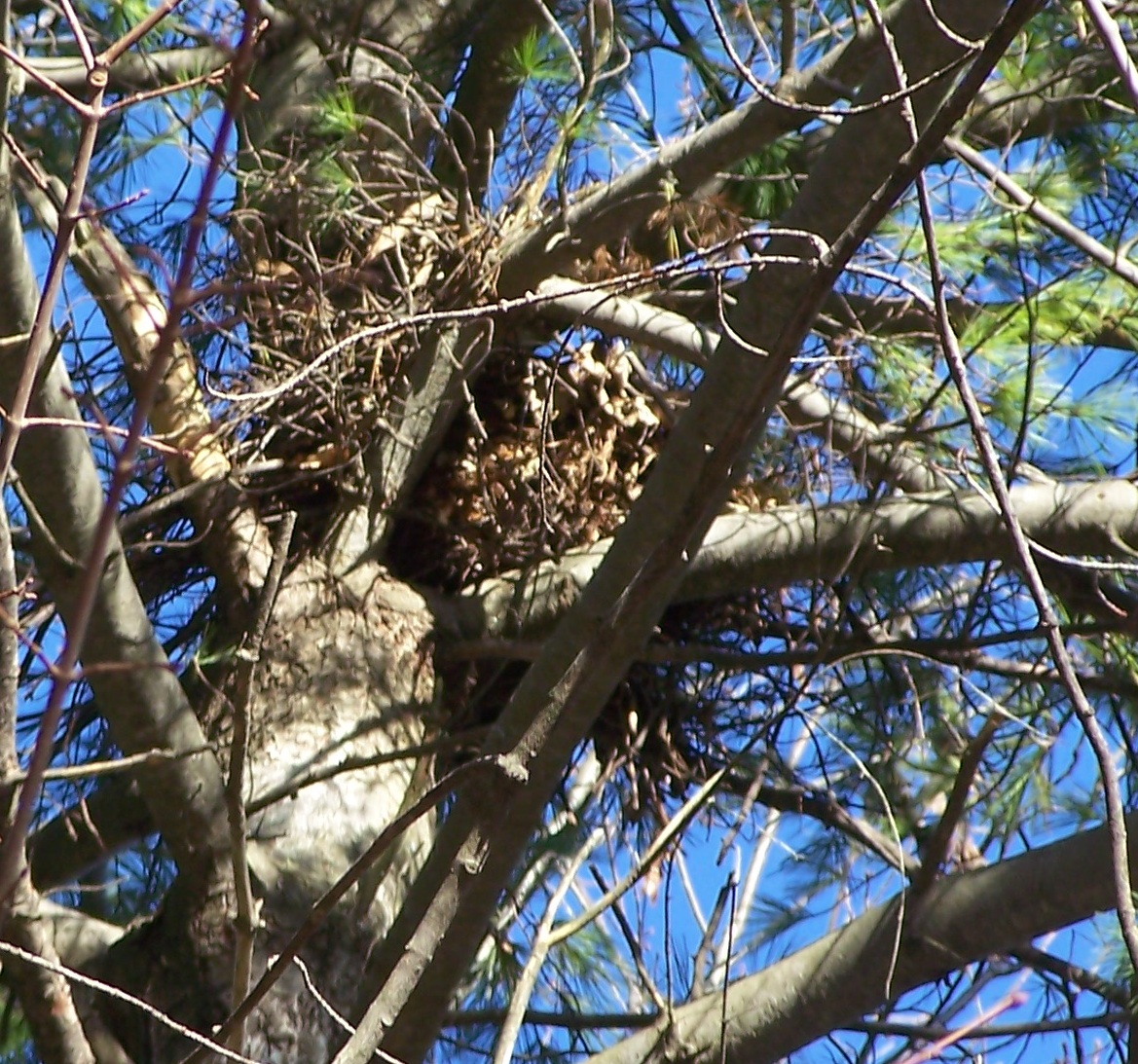
Squirrel nest made of leaves, twigs, and pine needles
Phot by Brad Sylvester, copyright 2011. Do not copy.
Squirrels build nests out of leaves, pine needles, and twigs in the crook of the branches of a tree, generally quite high above the ground. The squirrel nest in the photo to the left was located about 40 feet up in my yard. These types of gray squirrel nests are fairly large, often measuring 18 inches or more in diameter. They are usually easily visible in the fall and winter after the leaves have fallen from deciduous trees or coniferous trees have shed some of their needle mass for the winter.

On the other hand, though, gray squirrels will also nest inside tree cavities that either occur naturally or were carved out by birds like woodpeckers. These can be much more difficult if not impossible to spot from the ground. When these kinds of nests are used, they'll alos be lined with soft materials like leaves and pine needles, presumably for comfort as well as insulation.

During rain, snow or very cold weather, squirrels will curl up in their nests for protection from the elements.

Gray squirrel babies are born in mid-summer and are blind and hairless like baby rats. They'll be cared for by their mothers in the nest that both parents helped to build until they are old enough to find or build their own places.

Quick Facts about the Gray Squirrel (Sciurus carolinensis):

Lifespan: The Adirondack Ecological Center puts the average lifespan of a gray squirrel at 1-2 years, but if they make it to adulthood, six years is more typical. The reords, says the AEC, is 12 years in the wild and 20 years in captivity.

Lifecycle: Baby Gray squirrels are born in the summer, usually in small litters of 2-3 babies after a gestation period of about 6 weeks, plus or minus a couple of days. They may stay in the nest for as little as 56 days or until the follwoing spring, depending upon when in the summer they were born. They'll be ready to start their own families in the summer following the one in which they were born.

When is it here? Gray squirrels live in New Hampshire all year round.

Where does the Gray Squirrel go in the winter? Gray squirrels are active all winter long, but will hide in their nests during periods severe weather or extreme cold. They survive on hidden foods stores buried during the bountiful summer. They'll even burrow under the snow to find buried caches of food.

Are gray squirrels dangerous? While it is theoretically possibel for a squirrel to catch and transmit rabies, this is rare to the extreme and, according to eMedTV.com, there are no recorded cases of a human catching rabies from a squirrel bite. However, they should still be treated as wild animals that will inflict a painful bite subject to infection.

Notes: Gray Squirrels belong to the order of Rodentia (Rodents) characterized by their large front incisors which have a chisel shape for efficient gnawing. Sometimes squirrels will gnaw their way into a house and set up residence inside the wood-framed walls or in the attic.