Showing posts with label rodents. Show all posts

Friday, February 3, 2012

To catch a deer mouse (Peromyscus maniculatus)

Notice the bicolored tail, dark above, white below, on the
deer mouse (Peromyscus maniculatus)
Photo by Brad Sylvester. Copyright 2012.
There are a number of different species and subspecies that are popularly called deer mouse, wood mouse, or white-footed mouse. Many have a similar appearance and if you just catch a glimpse of one or are just looking at a top view as it sits in a bucket waiting to be carried far away from the house, then it can be hard to tell the difference between them. This appears to be a deer mouse of the species Peromyscus maniculatus.
One of the best websites detailing the differences between the deer mouse and similar species is enature.com. The tail is one key point of identification. In Peromyscus maniculatus, the tail is dark above and light below. There’s a clear demarcation of the two colors on the tail which should be about the same length as the rest of the mouse. The bicolored tail is shown clearly in the photo at the top left of this post.

The white underbelly with the tail details, the color of the top of the mouse’s body, the large, bulging eyes, and the location where it was found (New Hampshire) make it a pretty sure bet that this is, in fact, Peromyscus maniculatus, even though there are four species of mice that are native to New Hampshire and one (the house mouse – Mus musculus) that was introduced from Europe and is now firmly established here and throughout North America . If you look up images of the species by the common name on the Internet, however, odds are about fifty-fifty that you’ll get something other than Peromyscus maniculatus.

Deer mice typically live in the forest and fields and do quite well without coming into human houses during the winter. They will burrow under the snow seeking seeds and other edible plant material. In my yard, they will eat the soft green bark of bushes and shrubs below the snow so the damage isn’t visible until the snow melts in the spring. Once the snow does melt, however, the gnaw marks are very clear often girdling the bush (removing the bark all the way around it), which kills the plant.
From the top, not enough distinguishing features can be seen
for a positive identification of the deer mouse (Peromyscus
maniculatus).
Photo by Brad Sylvester. Copyright 2012.

We do, however, get an occasional mouse inside the house when there is a period of particularly cold or severe winter weather. They come in seeking better shelter and a more ready source of food.
Mice are prolific breeders. Just a couple slipping into the house can turn into an infestation if not quickly eliminated. Once inside, they’ll also look for whatever foods they can find there: dog food, cat food, my food.

For that reason, and because the area in which we live has carpenter ants which would like nothing better than to chew up the structural wood of our house until it falls down around our ears, our house is serviced regularly by an exterminator. They bait for rodents in the crawl spaces and little nooks and crannies where they might be otherwise found. This is quite effective and we generally don’t have mice around, at least not for very long.

Outside, however, there are the tunnels in the snow that reveal their presence and favored routes. To catch one, I just needed to put this live capture mouse trap , baited with peanut butter, in the walkway near the opening to one of the snow tunnels.   That's what led to the photo opp. for this little guy. This deer mouse was released unharmed.

Quick Facts about the Deer Mouse (Peromyscus maniculatus):

Diet: The deer mouse eats seeds, insects, berries, nuts and mushrooms. The US Forestry Service doesn't list the green inner bark of shrubs as part of the deer mouse diet, but I have the dead ornamentals to prove it, although they don't seem to choose it when other food is available in the summer. Since they seem to only eat it when it is under the snow, it is hard to catch them in the act. In this case, however, the tunnels, footprints, and captured deer mouse itself provide pretty solid evidence that this is the species that is eating the bark. 

Range: According to US Forestry Service, the deer mouse lives pretty much all throughout the continental United States except the extreme southeast (northern Georgia yes, Florida no). It can also be found in parts of Mexico and Canada west to southeastern Alaska.

Habitat: Deer mice live in just about every type of habitat: forests, fields, scrub, canyons, desert, you name it. They build nests just about everywhere, too. Deer mouse nests can be found high in trees, in underground burrows, in scrub piles, rock piles, and all sorts of man-made structures (like houses, cars, and barbecue grills) where they can stuff leaves, grass and other soft insulation to make it more comfortable.

Reproduction: Litter sizes may range from one to nine, but three to five is more typical. Gestation lasts 22-26 days and females may have several litters each year. The US Forestry site says that as many as 14 litters in a single year have been reported. At about 48 days of age, female deer mice are sexually mature and ready to begin having litters of their own.

When is it here? The deer mouse is a year-round resident of New Hampshire.

Where does it go int he winter? The deer mouse does not hibernate and is fully active throughout the winter.

Territory:

Predators: What eats deer mice? Many New England animals eat deer mice. The owl, coyote, fox, bobcat, house cat, snakes, weasels, martens, fisher cats, mink, chickens, and even skunks will all eat deer mice either regularly or opportunistically. With so many predators, the deer mouse relies on frequent litters and rapid maturation to maintain its population.

Deer Mouse Taxonomy:

Kingdom: Animalia
Phylum: Chordata
Class: Mammalia
Order: Rodentia
Family: Cricetidae
Genus: Peromyscus
Species: Peromyscus maniculatus


Sourcing Note: Because the range of the deer mouse covers such a wide variety of climates and geography, there are variations in reports of diet, litter size, litter frequency and other aspects of behavior among different sources. They may all be correct for different regions, but I have used data from the US Forestry service website linked above for information that I have not directly observed myself.

Tuesday, January 17, 2012

Porcupine Dens in my Yard Confirmed by Trailcam

A porcupine heads out for a snack in the dark of night. The
grizzled white areas on it's back and tail are the areas of
heaviest quill concentration.
Photo by Brad Sylvester. Copyright 2012, Do not copy.
In my previous entry, I wrote about a path of footprints leading out from two holes in the ground in the forested part of my yard. Well, for each of the last two nights, my trailcam has captured pictures of the creatures that are using the underground dens to escape the winter cold. As I suspected, they are porcupines or taxonomically speaking, Erethizon dorsatum.

The resolution of the camera is not high enough to tell for certain how many individuals are living in the dens, but from size differences of those porcupines photographed, I would say there are at least three. At least one is much smaller than the others and was probably born this past summer. I have known that porcupines lived on my property for some time, but I did not know they had a den here. Indeed, it may be only a temporary den for the winter as I have never seen tracks or other signs of porcupine occupancy there prior to last week.

Although generally nocturnal, it's not too unusual to
see procupines during daylight hours. This one, shown
disappearing into its den, was active in the middle
of the afternoon.
Photo by Brad Sylvester. Copyright 2012. Do not copy.
Porcupines are generally nocturnal feeders, but can be found out and about during daylight and dusk from time to time as well. As I mentioned last time, they don't hibernate or even fall into a winter torpor. Their thick coating of hair and quills provide them with insulation and there primary foods are available all year round.

Porcupines can cause terrible injury in dogs or any animal that attempts to touch them, but they are one of nature's best examples of a passive-aggressive creature. Porcupines respond to threats by turning away and slowly walking off as if they have no care in the world. In reality, their tails and backs are where their quills are thickest. Any attack from the rear is almost certain to result in more pain and injury to the attacker than to the porcupine. If the attacker gets too close for comfort, the porcupine will flick its quill-covered tail at them and do its best to turn the attacker into a pin cushion.

Porcupette Video. Copyright Brad Sylvester 2012
Porcupine quills have a very sharp point at the end and have small, scale-like barks that prevent them from being easily backed out once the penetrate the skin. Instead, they actually work themselves deeper over time. Porcupine quills can be quite painful and may result in serious infections if not removed and the wounds treated.


A porcupette looks down from an overhead branch. The
rodent's chisel-like incisors are visible.
Photo by brad Sylvester. Copyright 2010. Do not copy.
 Despite this defensive armament, the porcupine does fall victim to several New England forest predators on a regular basis. The most accomplished porcupine hunter is probably the fisher cat. I've been told that fishers attack porcupines in one of two ways. They'll harry the porcupine using their own speed and agility to stay out of reach. The fisher attacks the porcupine's head until the porcupine is completely exhausted (or dead) and can no longer turn its back fast enough to defend itself. Then the fisher will flip the porcupine over and eat from its unprotected underside. Another technique is to attack a treed porcupine from below as it clings to a branch. From that angle, its unquilled belly is exposed. I haven't seen either of these behaviors to confirm these modes of attack, but that's what folks around here say.

Trailcam video. Copyright Brad Sylvester 2012.
Bobcats and coyotes are also known to kill and eat porcupines as well. The head is largely undefended and frontal attacks against the porcupine are the least dangerous for the attacker. We have all three porcupine predators in New Hampshire and both bobcats and coyotes have been present on my property on more than one occasion since I moved here in 2007.

Quick Facts About the Porcupine (Erethizon dorsatum)

Size: Porcupines are the second largest rodent in North America. Only beavers are bigger. Adult male porcupines can weigh 35 pounds or more, but 12-15 pounds is a more common adult weight. Porcupines may measure more than three feet long and over a foot tall at the shoulder.

Lifespan: up to 15 years in the wild

Diet: Mainly the soft inner bark of trees, young evergreen needles, and plant buds. Hemlock is a favorite. In the spring and summer, porcupines will also eat grass and other green plants, fermenting fruit, seeds and some tubers. They are also known to chew treated wood or even rubber for the salt and mineral taste and may become a nuisance by eating the bark of fruit trees, sometimes girdling branches or the trunk and killing them. As a child, I remember hiking the Long Trail in Vermont and often finding porcupines chewing away contently at the wooden lean-tos built along the trail by the Forestry Service.

Where does it live? Porcupines live throughout the northern United States and Canada. According the IUCN information page, it can also be found further south in the west, even into northern Mexico.

Habitat: Porcupines most often inhabitat mixed forests, but in the spring can be found feeding on grass in open fields, especially when they are caring for a young porcupette. In the southwest, says the IUCN, they may live in desert scrub. Further north, they also live in the Canadian tundra.

When is it here? The North American porcupine lives in New Hampshire all year round?

Where does it go in winter? No place special, the porcupine does not hibernate or fall into a winter torpor. If the weather is especially cold or severe, they may form communal dens for a time during the winter, leaving each night to feed.

Breeding: Porcupines mate from September to December. They give birth usually to a single baby about seven months later. Males often fight viciously and noisily over females during mating season.

IUCN redlist status: Species of least concern. Wide distribution and large population.

Notes of interest: Each porcupine has over 30 quills. Baby porcupines are called porcupettes. Porcupines are very good climbers, but slow and awkward on the ground.

Porcupine Taxonomy:
Phylum: Chordata
Class:  Mammalia (Mammals)
Order: Rodentia (Rodents)
Family: Erethizontidae
Genus: Erethizon
Species: Erethizon dorsatum
---
Update: My new YouTube channel: @WhatLivesinmyYard talks about the porcupine in Episode 1.

Saturday, November 19, 2011

Gray Squirrel (Sciurus carolinensis): Trailcam Fail

The bushy tail in the center of the bottom edge of this trialcam
photo is enough to identify this animal as a
gray squirrel.
Photo by Brad Sylvester, copyright 2011. Do not copy.
In my last post, I talked about setting up my trailcam to try to catch some photos of what I presumed would be a squirrel that had left some telltale signs at the base of a tree. I worried that the trigger time of the camera would be too slow to catch a fast-moving squirrel as it scooted up and down a tree trunk. It appears that I was correct to worry. Although the trailcam captured 20 very nice pictures of a tree trunk, it appears to have captured only one single picture of a bushy tail at the lower edge of the frame.

Fortunately, this is enough to make a positive identification of the pine seed eating visitor as a Gray Squirrel (Scuirus carolinensis), also known as the Eastern Gray Squirrel. I was also able to catch some pictures of a gray squirrel in my yard with my regular camera during the daytime so that we can compare the tail captured by the trailcam with a known gray squirrel. I can't tell whether this is the same gray squirrel in both locations, about fifty yards apart.

Although naturally skittish, gray squirrels may
become acclimated to human presence by regular
feeding. This is generally a bad idea as they often
become quite inistent and may become pests.
Photo by Brad Sylvester, copyright 2011. Do not copy.
Unlike many animals, gray squirrels don't tend to be particularly territorial over their feeding range, especially outside of breeding season. During breeding season, they'll defend their nesting locations from other squirrels fiercely with loud, aggressive vocalization and physical attacks, driving intruders away and chasing them until they are far enough away to pose no threat.

Even during this time, however, they will eat side by side near a bird feeder or other source of food without too much issue, it is only the home base that seems to instill territoriality instincts in the gray squirrel. This shouldn't be mistaken for the courtship chases as the male often chases the female through the branches of trees as well. Gray squirrels are opportunistic breeders and don't form mated pairs.

The gray squirrel gets its name from its color as you would expect. It is predominantly gray, but has some brown or reddish patches, commonly on top of its back, on its face, and on its legs or feet. Despite these reddish markings, it is quite different in appearance than the red squirrel which is predominantly reddish in color, almost fox-red, and which is much smaller than the gray squirrel.

The gray squirrel is the largest of the eastern tree squirrels and adults are typically 1-1.5 lbs in weight and about 20 inches long, half that length comprised of the tail. In New Hampshire (and many other states), gray squirrels are considered a game animal and may be hunted in season (September 1st- December 31st in New Hampshire). In this state, hunters are permitted to take as many as 5 gray squirrels each day as per information published on the NH Fish & Game website. Despite this, gray squirrels are abundant and thriving throughout New England.

Gray Squirrel looking for dropped birdseed under a feeder.
The brownish-red patch on its back is visible here.
Photo by Brad Sylvester, copyright 2011. Do not copy.
Gray squirrels have adapted well to a suburban lifestyle, raiding gardens and bird feeders at every oipportunity. Gray squirrels will tend to store their food for the lean winter months by caching or hiding it away. They are known as scatter cachers because they make many hundreds or thousands of food stores rather than storing it all in one central location. They'll bury acorns and other seeds all thoughout the spring, summer, and early fall or place them in tree cavities for retrieval when the snow is deep. When winter arrives, they'll seek out these hidden stores and eat them, but they don't find all that they've hidden making them a prolific planter of new forest trees. It's not clear whether they remember the locations as well as the Clark's Nutcracker, a scatter caching bird that is well known for its ouistanding spatial memory, or if they just go back to areas where they found food during the summer and then sniff our buried seeds.

Gray squirrels are quite fond of acorns and, as previously mentioned, pine seeds, but they will eat many varieties of seeds, nuts, and fruit as well as insects and defenseless animals such as baby birds. In New England maple seeds are plentiful and are also a part of the diet of the gray squirrel. They'll raid gardens from time to time as well.

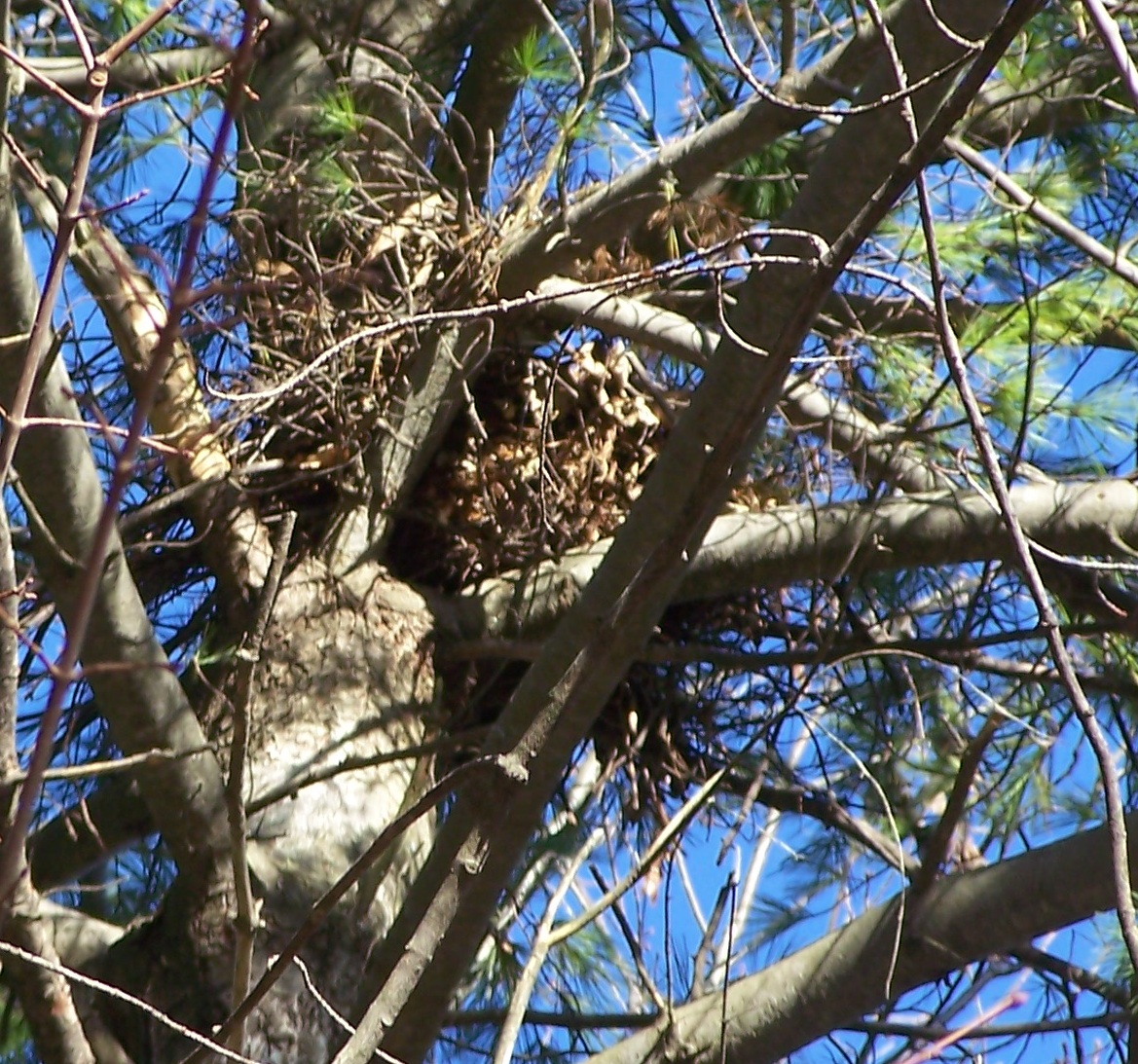
Squirrel nest made of leaves, twigs, and pine needles
Phot by Brad Sylvester, copyright 2011. Do not copy.
Squirrels build nests out of leaves, pine needles, and twigs in the crook of the branches of a tree, generally quite high above the ground. The squirrel nest in the photo to the left was located about 40 feet up in my yard. These types of gray squirrel nests are fairly large, often measuring 18 inches or more in diameter. They are usually easily visible in the fall and winter after the leaves have fallen from deciduous trees or coniferous trees have shed some of their needle mass for the winter.

On the other hand, though, gray squirrels will also nest inside tree cavities that either occur naturally or were carved out by birds like woodpeckers. These can be much more difficult if not impossible to spot from the ground. When these kinds of nests are used, they'll alos be lined with soft materials like leaves and pine needles, presumably for comfort as well as insulation.

During rain, snow or very cold weather, squirrels will curl up in their nests for protection from the elements.

Gray squirrel babies are born in mid-summer and are blind and hairless like baby rats. They'll be cared for by their mothers in the nest that both parents helped to build until they are old enough to find or build their own places.

Quick Facts about the Gray Squirrel (Sciurus carolinensis):

Lifespan: The Adirondack Ecological Center puts the average lifespan of a gray squirrel at 1-2 years, but if they make it to adulthood, six years is more typical. The reords, says the AEC, is 12 years in the wild and 20 years in captivity.

Lifecycle: Baby Gray squirrels are born in the summer, usually in small litters of 2-3 babies after a gestation period of about 6 weeks, plus or minus a couple of days. They may stay in the nest for as little as 56 days or until the follwoing spring, depending upon when in the summer they were born. They'll be ready to start their own families in the summer following the one in which they were born.

When is it here? Gray squirrels live in New Hampshire all year round.

Where does the Gray Squirrel go in the winter? Gray squirrels are active all winter long, but will hide in their nests during periods severe weather or extreme cold. They survive on hidden foods stores buried during the bountiful summer. They'll even burrow under the snow to find buried caches of food.

Are gray squirrels dangerous? While it is theoretically possibel for a squirrel to catch and transmit rabies, this is rare to the extreme and, according to eMedTV.com, there are no recorded cases of a human catching rabies from a squirrel bite. However, they should still be treated as wild animals that will inflict a painful bite subject to infection.

Notes: Gray Squirrels belong to the order of Rodentia (Rodents) characterized by their large front incisors which have a chisel shape for efficient gnawing. Sometimes squirrels will gnaw their way into a house and set up residence inside the wood-framed walls or in the attic.