Saturday, December 10, 2011

Trailcam catches a white-tailed deer- finally!

The broad, brown tail with a white tip confirms the species
as a white-tailed deer.
Photo by Brad Sylvester, copyright 2011. Do not copy.
After determining that white-tailed deer do, indeed, live in my yard based on the tracks they left in the snow and the droppings they left, I placed my trailcam in a spot that I thought was likely to be frequented by passing deer. The evidence of tracks in the snow at this location made that an easy choice, but there are other clues that this might be a good travel route for deer as well.

Glens (long, shallow valleys among the hills) are
often preferred terrain for deer trails.
Photo by Brad Sylvester, copyright 2011. Do not copy.
The daylight photo at the right shows the terrain a little better. You'll notice that it is relatively clear of underbrush, making it easy for deer to walk through. Second, a little glen runs through this particular area. A glen, of course, is a small valley-like area or a low point with higher ground on either side. Deer seem to choose glens, most likely for the natural cover they provide, as their preferred  routes of travel through the forest.

Male or Female?

At this time of the year, male white-tailed deer have antlers for the rutting season. later in the winter, their antlers will fall off, but for now (and during hunting season) antlers are the easier way to distinguish bucks from does. The lack of antlers on this deer says that it is a doe. From the size relative to the plants around it, it looks as though it is an adult female. It looks well-fed.

Determining a Deer's Sex with Hoof Prints

In the photo, you can see that as this deer is walking, it move its right front and left rear feet at the same time and vice versa. With each step the rear foot comes up near the front foot of the same side.
When tracking deer, I've been told that you can tell the sex from the hoof prints alone. I didn't know if it was true, but this picture seems to confirm what I've heard. The story goes like this: female deer walk with their rear feet outside (or wider) than their front feet because they have wider hips for giving birth. Bucks, on the other hand, have broad, muscular chests to carry the weight of and fight with their antlers. This widens the distance between their front feet making the buck's front feet wider apart than their back feet. I can't verify the accuracy of this method, but that's what I've always heard and this picture of a doe confirms that her rear feet are indeed wider than her front feet. With a number of similar photos of both sexes, we could answer this for sure, one way or the other.The rear foot will often be placed either a bit behind the front foot print, or even on top of it, partially covering it.

Trailcam Photo Quality 

The trail cam photo of white-tailed deer at the top left of this entry has been adjusted by me using a basic photo editor. I adjusted brightness and contrast until I felt the deer was easier to see. You'll notice the small branch in front of the camera that seems to have affected the focus a bit. I've removed the branch so that, hopefully, the next photo will be clearer. The original, unretouched photo is at the lower left of this entry.

Unadjusted trailcam photo taken using an infrared
flash in the dark of night.
Photo by Brad Sylvester, copyright 2011. Do not copy.
You can also see from the time stamp on the photo that it was taken at 2:58 a.m. EDT on the morning of December 10th. That was the day before a full moon and there was quite a bit of moonlight giving good visibility that night. The trailcam's date stamp feature lets you know what time deer are active at specific locations. BY tracking time patterns, you can see if a particular deer uses the trail regularly, perhaps to journey back and forth to a preferred feed spot.

I've mentioned previously that deer tend to feed in the early evening hours and early morning hours, right around dusk and dawn. Remember what animals with this pattern are called? They are called crepuscular feeders. White-tailed deer are often hunted during the daylight hours when they can be found walking around actively. Finding them active also at this late hour of the night means that deer can be found roaming the woods at practically nay hour of the day or night.


Sunday, December 4, 2011

White-tailed deer drops more clues in my yard

Pile of droppings from a white-tailed deer.
Photo by Brad Sylvester. copyright 2011. Do not copy.
In my last entry, I showed the tracks of the white-tailed deer in the shallow snow in my back yard. Read details about deer tracks and white-tailed deer information at this entry. I have had the trailcam set up for 24 hours in a position where the tracks suggest deer pass fairly regularly. Checking it this morning, it recorded no activity.

However, I did find new evidence of white-tailed deer living in my yard yesterday morning when I was setting up the trail cam. That evidence was scat or deer droppings. As I mentioned in the previous post, white-tailed deer are ruminants, meaning they have several chambers in their stomachs and chew their cud to get the maximum amount of nutrition from their food. This results in droppings or scat with a very uniform consistency, there are no identifiable bits of wood fibers or anything else in white-tailed deer scat.

Detail of white-tailed deer scat showing tapered nub at
the ends of the pellets.
Photo by Brad Sylvester. Copyright 2011. Do not copy.
White-tailed deer scat takes the form of a small pile of pellets each measuring roughly 5/8" in length. The pellets are all very similar in shape. They are little ovals with a small nub at the end as it tapers down as shown in the detail picture to the right. Rabbit pellets will be distinctly round as opposed to oval shaped. Porcupine pellets will vary in length and shape as opposed to uniform deer pellets.

Some animals leave droppings outside their dens and it eventually builds up to large accumulations of droppings. Deer are not one of these. Deer droppings will be found in small, isolated piles along the path the deer followed.

Depending upon the deer's diet, the pellets may all be stuck together in a clump, but in my experience, this is fairly rare in New England and you are much more likely to find deer droppings as individual pellets as shown in the photos on this page.

Determining the Age of Deer Scat

The exact color of the white-tailed deer's scat may vary according to diet as well. Generally black to dark brown when fresh and turning light brown to tan when old and thoroughly dried out. The dropping shown in these pictures are between 2 days and 5 days old. I can tell that they are fairly fresh from the look of them, but I walked the trail on which they were found several times a week and so was able to establish that time window for their deposit. If you slice them in half, deer droppings tend to dry out from the inside out and you can tell about how old they are by the amount of drying inside. I'm not cutting these open to demonstrate. It takes some practice, but to learn the typical drying patterns, find a fresh pile along a frequently travelled trail and cut open a pellet every day so you know the exact age of the scat and can see how much it dries each day. This may vary by the season and weather, as well. Then, when you are hunting or scouting hunting locations, you'll be able to tell the approximate age of the scat and determine how fresh the trail you're following may be.

Other aging clues are the amount of fallen leaves or other debris on top of the scat pile or snowfall.

With the tracks I had already found, I was quite confident that white-tailed deer lived in my yard. Now, the scat provides even more solid evidence of their frequent presence in my back yard, so we can definitely say that white-tailed deer live in my yard.

Sunday, November 27, 2011

Tracking White-tailed Deer in my Backyard

Even though it is old and detail has been lost due to
melting snow, we can still be sure that this track was
left by a white-tailed deer.
Photo by Brad Sylvester, copyright 2011. Do not copy.
In the summer, it can be difficult or impossible to know how many animals or what species walk through the woods in my back yard. I can set out a trail cam, listen at night, or sit quietly and wait for something to walk by, but these areimperfect methods at best. Many animals will smell me and avoid the area,  get missed by the trailcam's motion detector or pass by so silently that I never notice them. In the winter of New England, however, it is a different story.

Animal Tracks in the Snow

That different story is told by tracks in the snow. After a fresh, light snow, animals make very clear and distinct footprints that identify them as accurately as a good photograph. Of course, that only applies to fresh prints that have not had time to melt and lose their detail. Today, three days after four inches of snow fell, I went out to see what kinds of tracks I could find in the woods in my back yard. It is a warm day, and it's been warm for several days since the snow fell so it has mostly melted away. There is still about an inch or two of snow in most places in the woods, but is it slushy and wet.

Nevertheless, even with fine details metled away into oblivion, there is enough evidence to give us some idea of the animals that have passed by.

Hoof Prints in the Snow

Tracks of a white-tailed deer walking
calmly through my backyard.
Photo by Brad Sylvester, copyright 2011.
Do not copy.
Some animals tracks are very distinctive and are very difficult if not impossible to mistake even when most of the detail is gone. One such set of prints are those of the white-tailed deer (Odocileus virginianus). It is one of just two common hooved animals in the forests of New Hampshire. The other is the moose which has much larger feet. This, of course, excludes hoofprints found on the roof of a house after December 25th, which could only be magical reindeer.

Moose Prints or Deer Prints?

So when we see footprints that look like those in the photo at the beginning of this entry, with two distinct halves in each print, a twin-teardrop or arrowhead shape, and a lack of individual toes, we can be pretty certain that they are deer or moose prints. Deer footprints tend to max out at about 3" in length, while moose prints typically run 4.5-5.5" in length. The one thing of which we need to be careful, however, is that footprints in melting snow tend to get bigger over time. If the snow melts a bit, refreezes and melts a bit more, the apparent size of the prints can be quite different than they were when fresh.

How Many Deer Live in my Backyard?

In walking through my back yard, I ran across about half a dozen separate sets of deer footprints. I don't count single paths with multiple sets, because it may be the same animal walking back and forth over the same familiar path. Indeed there's no real way to know if the same animal made more than one set of prints in different areas. If the prints were fresh and distinct, I could measure them and those of different sizes could be attributed to different individuals. Because these are old, and the snow is melting, no reliable measurement can be made.

By finding places where there are multiple sets of deer prints, I can find a good location to set up my trailcam to try to get some pictures of the white-tailed deer that live in my yard.

Do These White-tailed Deer Really Live in my Backyard?

My yard is only about 5.25 acres, of which about 1 acre is cleared and the rest forested. This not even close to enough room for a deer to live all the time. a white-tailed deer will range over an area of about one square mile even if food is plentiful. If food is scarce, then it may cover much more area. So while these deer don't reside in my yard 24 hours a day. My yard is certainly within their normal territory so we can say, yes, these white-tailed deer do live in my yard at least part-time.

In other parts of the country there are other species of deer so the identification from footprints would be much less certain, but in New Hampshire, excluding escaped farm livestock, there only moose and white-tailed deer that might leave hoof prints.

Finding a Fawn All Alone

If you should find a tiny fawn lying alone in the grass, rest assured that it has not been abandoned. When danger is near, the mother will hide the babies in the grass where they will lie flat and still until the mother's return. If the mother has more than one fawn, she will have each one hide in different places.

Quick Facts about White-tailed Deer?

When do they live here? White-tailed deer live in the forests of New Hampshire all year round.

Where do they go in winter? White-tailed deer do not hibernate and are active all winter long. They may take shelter under the branches of evergreen trees or in thich brush to escape the elements durign a particularly harsh winter storm.

Diet: White-tailed deer are herbivores (vegetarians). They will graze on grass in open fields and the eat tender shoots of young ground plants and  during the summer. In the fall, they may eat nuts and fallen fruit. During the winter, when there is a deep snow cover, they  will eat the buds and ends of small softer twigs from trees (which can be a problem for home-owners with ornamenal landscape shrubs like lilacs). Deer, like cows, are ruminants which means they have a stomach with multiple chambers (four) and regurgitate their food after it is partially digested to chew it a second time. This is called chewing their cud.

How big do white-tailed deer get? A big male can reach as much as 300 pounds in weight. The largest deer taken by hunters in New Hampshire in 2010 weighed 289.5 pounds according to NH Fish & Game Department records.

How fast can white-tailed deer run? Over short distances, white-tailed deer can run about 30 miles per hour. This is roughly equal to an average full-sized dog in good physical condition, but dogs can likely keep up the pace longer than the deer chasing it until it is too exhausted to escape or put up much of a defense.

What are the main predators of white-tailed deer? Humans are the main predators of white-tailed deer. In New Hampshire in 2010, hunters killed 9759 deer. Domestic dogs are the second largest killer of wild deer in New Hampshire.

Lifecycle of White-tailed Deer: Deer mate during a rutting season in the fall and early winter. Fawns are born about 7 months later. Typically, the female will give birth to one or two fawns each season. The babies may remain with the mother for one to two years before going off on their own. They reach adulthood after about 16-18 months are are ready to have babies of their own by the fall of their second year.

Lifespan: White-tailed deer usually live about 2-3 years. Maximum lifespan would be 20 years, but, says the University of Michigan's Animal Diversity Web, "few live past 10 years old." That's largely due to hunting fatalities.

Range: With the exception of the desert Southwest, white-tailed deer can be found throughout the 48 states and through southern Canada.

Interesting Notes: With adult males weighing 200-300 pounds, the white-tailed deer is the largest animal living in my yard that we've identified to date (although there are two larger animals that may also live here, we haven't identified them since I started this blog).

When a deer is walking at normal speed, the hoofprints will tend to be shaped like an arrowhead with the points at the front coming together. When it is running, however, the points tend to splay outward so that the front tips are angled away from each other.

Male white-tailed deer grow new antlers each year and then shed them typically between January and March after mating season has ended. The antlers are used to defend territory from other males during the mating or rutting season which makes the antlers at the largest size of the year during hunting season November-December. Females do not grow antlers at all.

Monday, November 21, 2011

Black-capped Chickadee (Poecile atricapillus)

The bright clean feathers on this chickadee indicate that
the photo was taken in late fall or winter. The feathers will
in the late summer before being replaced.
Photo by Brad Sylvester, copyright 2011. Do not copy.
As you may know, I am a freelance writer by trade. One of the regular columns I write is the Manchester Bird Watching Examiner at Examiner.com. I just published an article there about one of the birds that lives in my yard, the black-capped chickadee (Poecile atricapillus). In the article, I discussed the complex set of vocal signals the black-capped chickadee uses to communicate with others of its species and even with other species of birds. If you find the idea of language being used by animals other than humans as interesting as I do, you can read "The Language of Chickadees" at this link to learn what they are saying with their different songs and calls.

Meanwhile, let's discuss the bird as another of the animals that lives in my yard.

The black-capped chickadee is another year-round resident in New Hampshire. In the spring and summer they set-up housekeeping and establish nests. In the winter, they are a bit more cooperative forming groups of six or eight birds that tend to stick together in a small flock. They don't generally migrate from New Hampshire, but extremely harsh winter weather may periodically push them south as they search for food and respite from the very coldest temperatures. This, as I mentioned in a previous post, is called irruptive migration.

Black-capped Chickadee Nesting Habits


Chickadees are quite happy in suburban settings as well as on the forest edge or clearings deep within forests. They nest in hollowed out tree cavities which they either find or dig themselves. They can also be tempted into using artificial birdhouses located 6-15 feet off the ground and placed in or on the edge of the forest. They'll line these cavities with soft plant material such as moss, pine needles, and the soft down of plants like thistles or milkweed. Of course, man-made materials that they find will be used as well. In our yard, we often brush our dog's coat in the pring and early summer as she is shedding and we leave the hair on the lawn for the birds to use in their nests.

Chickadee eggs are quite small, about 5/8 inches in diameter. They are white with brown spots and are typically laid in clutches of 6-8 eggs. Instead of laying them all at once, the black-capped chickadee will lay one egg each day until the clutch is complete. The young hatch blind and featherless, but are ready to leave the nest in just 16 days after hatching. Adults measure 5 inches in length.

Quick facts about the Black-capped Chickadee (Poecile atricapillus):

Lifespan: Although generally considered to live about 2-3 years, Ehrlich, Dokin and Wheye of Stanford University state that the longest recorded lifespan for a black-capped chickadee is 12 years, 5 months.

Black-capped chickadee (Poecile atricapillus) at a
suet feeder.
Photo by Brad Sylvester, copyright 2011. Do not copy.
Diet: Chickadees are primarily seed eaters in the winter and are frequent vistors to backyard bird feeders. As you can see in the photo to the right, they will eat suet as well. During the summer, they'll flit from branch to branch in trees and shrubs looking for bugs to eat.

When is it here? Black-capped chickadees are found in New Hampshire all year round.

Where does it go in the winter? Chickadees are active all winter, relying on seeds and berries that are left on trees and bushes or the seed and suet put out in birdfeeders.

Notes: Although most of us know the "chick-a-dee-dee-dee" warning call of the black-capped chickadee, the usual call is a smooth, lazy "Feee-beee" that has a much more musical sound.

Saturday, November 19, 2011

Gray Squirrel (Sciurus carolinensis): Trailcam Fail

The bushy tail in the center of the bottom edge of this trialcam
photo is enough to identify this animal as a
gray squirrel.
Photo by Brad Sylvester, copyright 2011. Do not copy.
In my last post, I talked about setting up my trailcam to try to catch some photos of what I presumed would be a squirrel that had left some telltale signs at the base of a tree. I worried that the trigger time of the camera would be too slow to catch a fast-moving squirrel as it scooted up and down a tree trunk. It appears that I was correct to worry. Although the trailcam captured 20 very nice pictures of a tree trunk, it appears to have captured only one single picture of a bushy tail at the lower edge of the frame.

Fortunately, this is enough to make a positive identification of the pine seed eating visitor as a Gray Squirrel (Scuirus carolinensis), also known as the Eastern Gray Squirrel. I was also able to catch some pictures of a gray squirrel in my yard with my regular camera during the daytime so that we can compare the tail captured by the trailcam with a known gray squirrel. I can't tell whether this is the same gray squirrel in both locations, about fifty yards apart.

Although naturally skittish, gray squirrels may
become acclimated to human presence by regular
feeding. This is generally a bad idea as they often
become quite inistent and may become pests.
Photo by Brad Sylvester, copyright 2011. Do not copy.
Unlike many animals, gray squirrels don't tend to be particularly territorial over their feeding range, especially outside of breeding season. During breeding season, they'll defend their nesting locations from other squirrels fiercely with loud, aggressive vocalization and physical attacks, driving intruders away and chasing them until they are far enough away to pose no threat.

Even during this time, however, they will eat side by side near a bird feeder or other source of food without too much issue, it is only the home base that seems to instill territoriality instincts in the gray squirrel. This shouldn't be mistaken for the courtship chases as the male often chases the female through the branches of trees as well. Gray squirrels are opportunistic breeders and don't form mated pairs.

The gray squirrel gets its name from its color as you would expect. It is predominantly gray, but has some brown or reddish patches, commonly on top of its back, on its face, and on its legs or feet. Despite these reddish markings, it is quite different in appearance than the red squirrel which is predominantly reddish in color, almost fox-red, and which is much smaller than the gray squirrel.

The gray squirrel is the largest of the eastern tree squirrels and adults are typically 1-1.5 lbs in weight and about 20 inches long, half that length comprised of the tail. In New Hampshire (and many other states), gray squirrels are considered a game animal and may be hunted in season (September 1st- December 31st in New Hampshire). In this state, hunters are permitted to take as many as 5 gray squirrels each day as per information published on the NH Fish & Game website. Despite this, gray squirrels are abundant and thriving throughout New England.

Gray Squirrel looking for dropped birdseed under a feeder.
The brownish-red patch on its back is visible here.
Photo by Brad Sylvester, copyright 2011. Do not copy.
Gray squirrels have adapted well to a suburban lifestyle, raiding gardens and bird feeders at every oipportunity. Gray squirrels will tend to store their food for the lean winter months by caching or hiding it away. They are known as scatter cachers because they make many hundreds or thousands of food stores rather than storing it all in one central location. They'll bury acorns and other seeds all thoughout the spring, summer, and early fall or place them in tree cavities for retrieval when the snow is deep. When winter arrives, they'll seek out these hidden stores and eat them, but they don't find all that they've hidden making them a prolific planter of new forest trees. It's not clear whether they remember the locations as well as the Clark's Nutcracker, a scatter caching bird that is well known for its ouistanding spatial memory, or if they just go back to areas where they found food during the summer and then sniff our buried seeds.

Gray squirrels are quite fond of acorns and, as previously mentioned, pine seeds, but they will eat many varieties of seeds, nuts, and fruit as well as insects and defenseless animals such as baby birds. In New England maple seeds are plentiful and are also a part of the diet of the gray squirrel. They'll raid gardens from time to time as well.

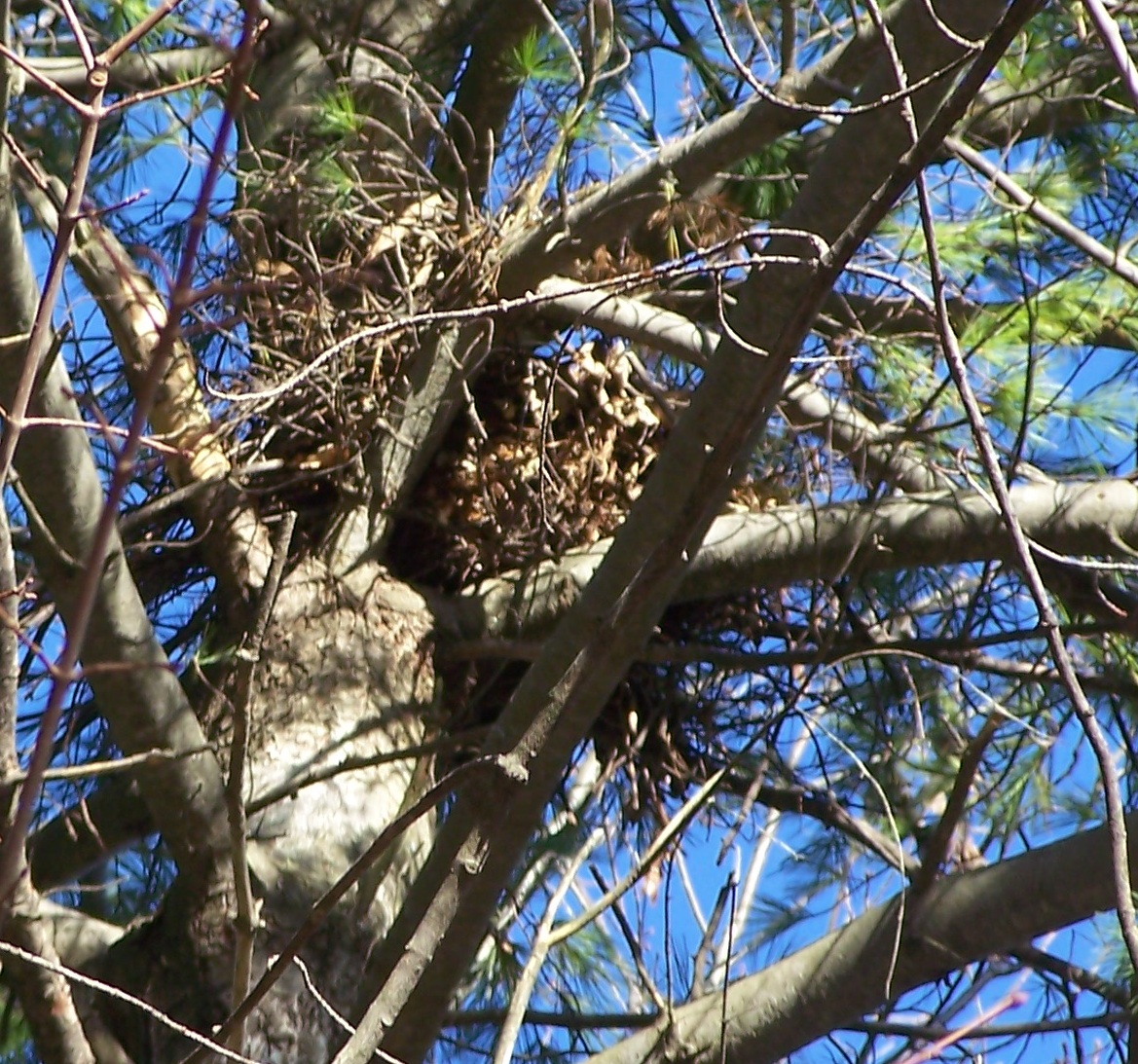
Squirrel nest made of leaves, twigs, and pine needles
Phot by Brad Sylvester, copyright 2011. Do not copy.
Squirrels build nests out of leaves, pine needles, and twigs in the crook of the branches of a tree, generally quite high above the ground. The squirrel nest in the photo to the left was located about 40 feet up in my yard. These types of gray squirrel nests are fairly large, often measuring 18 inches or more in diameter. They are usually easily visible in the fall and winter after the leaves have fallen from deciduous trees or coniferous trees have shed some of their needle mass for the winter.

On the other hand, though, gray squirrels will also nest inside tree cavities that either occur naturally or were carved out by birds like woodpeckers. These can be much more difficult if not impossible to spot from the ground. When these kinds of nests are used, they'll alos be lined with soft materials like leaves and pine needles, presumably for comfort as well as insulation.

During rain, snow or very cold weather, squirrels will curl up in their nests for protection from the elements.

Gray squirrel babies are born in mid-summer and are blind and hairless like baby rats. They'll be cared for by their mothers in the nest that both parents helped to build until they are old enough to find or build their own places.

Quick Facts about the Gray Squirrel (Sciurus carolinensis):

Lifespan: The Adirondack Ecological Center puts the average lifespan of a gray squirrel at 1-2 years, but if they make it to adulthood, six years is more typical. The reords, says the AEC, is 12 years in the wild and 20 years in captivity.

Lifecycle: Baby Gray squirrels are born in the summer, usually in small litters of 2-3 babies after a gestation period of about 6 weeks, plus or minus a couple of days. They may stay in the nest for as little as 56 days or until the follwoing spring, depending upon when in the summer they were born. They'll be ready to start their own families in the summer following the one in which they were born.

When is it here? Gray squirrels live in New Hampshire all year round.

Where does the Gray Squirrel go in the winter? Gray squirrels are active all winter long, but will hide in their nests during periods severe weather or extreme cold. They survive on hidden foods stores buried during the bountiful summer. They'll even burrow under the snow to find buried caches of food.

Are gray squirrels dangerous? While it is theoretically possibel for a squirrel to catch and transmit rabies, this is rare to the extreme and, according to eMedTV.com, there are no recorded cases of a human catching rabies from a squirrel bite. However, they should still be treated as wild animals that will inflict a painful bite subject to infection.

Notes: Gray Squirrels belong to the order of Rodentia (Rodents) characterized by their large front incisors which have a chisel shape for efficient gnawing. Sometimes squirrels will gnaw their way into a house and set up residence inside the wood-framed walls or in the attic.


Monday, November 14, 2011

Candid Camera: Using a trailcam to identify animals

Trailcam poised and ready to strike
Photo by Brad Sylvester, copyright 2011. Do not copy.
Last year, I spent about six weeks doing some volunteer work for a local conservation agency. As a thank you gift, they gave me a gift certificate to the Kittery Trading Post, an outdoor sports and recreation specialty store in Kittery, Maine. With the certificate, I bought a trailcam. A trailcam, for those who have never heard the term, is a camera designed to be left outdoors along a suspected game trail to photograph animals as they pass by. It uses a built-in motion detector to determine when animals pass by. Once the motion detector is triggered it snaps a photo. This particular model works in both daylight and in complete darkness as it has an infrared flash that enables night-vision photos.

The trailcam is an ideal tool to help me capture photos of the animals that live in my yard. It can be set up by a bird feeder to snap pictures of every bird that visits during the day, or it can be used to catch nocturnal or crepuscular creatures that live in my yard that I might never see myself. Today, though, I have set it up to try to catch a shy diurnal mammal that I know lives in my yard.

Stripped pine cones and loose scales mean that something
was eating pine seeds here.
Photo by Brad Sylvester, copyright 2011. Do not copy.
To determine where to place the camera, I look for clues like the one in the photo to the right. There are several pine cones here on the ground that have been stripped as some animal pulled them apart to get at the tasty pine seeds nestled inside the cone. I found a number of these pine cones around the base of a big tree, with many of the cones and associated debris on a large flat rock next to the tree. The rock makes a great lookout point from which a hungry, but wary little animal might work at the pine cone while watching all around for any threats. At other times it might take the pine cone up into the tree to eat in an even more secure location leaving pine cone scraps all around the base of its favorite tree.

I strongly suspect that this is the work of a squirrel. A chipmunk would also eat pine cones like this, but would most likely eat on the ground and not climb a tree for that purpose. Although it is not above using a tree to escape a predator, chipmunks are ground creatures. Their nests are burrows. Squirrels (with some exceptions), on the other hand, are more arboreal, which means they live in trees. They build nests in the high branches of a tree or a cavity in the trunk and raise their young there. They are more comfortable in a tree than on the ground and are more likely to take their food up into the canopy both to eat immediately and for winter storage.


Trailcam aimed at the base of a large pine tree in my
 front yard where the scraps of pine cones were
found in abundance.
Photo by Brad Sylvester, copyright 2011. Do not copy.
  Rather than placing a trail cam at any random location and hoping to catch something, finding clues that some animal frequents the spot first helps improve the odds of getting the picture you want. In this case, I set up the camera to aim at the base of the tree, on the side where the flat rock lies. The one thing I don't like about the camera is that there is a delay of a several seconds between the time when the motion detector is triggered and when the picture is taken. This is fine to allow larger, slow moving animals like deer to fully enter the camera's field of vision before it takes a picture, but for small, fast moving animals like squirrels, it can mean that they trigger the motion detector and are long gone before the picture is taken. We'll see how it works.

I'll post an update when I have some pictures to show of whichever animal has been eating the pine seeds. In New Hampshire, where I live, there are four species of "conventional" squirrels: the grey squirrel, the red squirrel, the northern flying squirrel and the southern flying squirrel. I say conventional squirrels because the woodchuck is actually a kind of squirrel as well, as is the chipmunk. I suspect the culprit in this case is either an eastern grey squirrel or a red squirrel.

Saturday, October 29, 2011

Snow Tracks of the Striped Skunk (Mephitis mephitis)

To paraphrase Robert Frost:
"Whose tracks are these?
I think I know.
It is the striped skunk,
The odor tells me so."

With the overnight snow a couple of days ago, I awoke to find meandering trails throughout the back yard where some creature had wandered all over the back lawn. The snow was wet and melting, so no distinct footprints could be discerned, but there is still enough evidence to identify the trail-maker.

The meandering route would be typical of a striped skunk (Mephitis mephitis) searching for grubs under the roots of the grass. Additionally, a couple of weeks ago, there was a very strong skunk odor out by the sun porch. It must have sprayed either under the porch or right next to it. The odor was literally strong enough to make a person sick until we aired it out the next morning. This evidence is enough to identify the striped skunk as the largest wild animal identified so far in this blog as a resident of my yard.

It leads me to wonder though: did the skunk run into some other creature living under the deck and use its defensive spray? It seems odd that it would find an occupied spot and then choose to live there. I suspect, however, that the skunk, out looking for a home used its musk to claim the spot. Any other animals in the area would be able to smell the skunk's spray for months, giving them a very good reason not to go near the skunk's winter den. I've never heard of this sort of behavior, but, logically, it makes sense to me. I'll have to do some further research.

I suspect the striped skunk has taken up residence beneath our house. It's odd to see its tracks in the snow, because skunks have usually gone into a winter torpor before snow sticks on the ground, as that doesn't often happen until the ground is frozen at the surface level, but this one is still actively hunting in the early snow. Young skunks often have a tough time surviving their first winter (see the Quick Facts below), so I'll be interested to see if it is still around in the spring.

Skunks can wreak havoc on a well-maintained lawn as they root for grubs. They will wander around the yard, digging little holes sporadically as they locate grubs. They'll also eat insects on the surface as they find them. Earthworms or beetles caught above ground make a nice addition to the skunk's diet. They also hunt larger prey such as mice, moles and frogs. They'll eat bird's eggs and berries and grains, as well. In an urban setting, bird feeders and garbage cans make attractive feeding stations for skunks if they are left within reach. Skunks are small and are generally unable to knock over a medium weight garbage can, but if bags of garbage are left out, they'll happily tear into them.

Skunks hunt at dusk and dawn and may sometimes be seen in the early morning hours as they finish up their feeding and head back to their dens for the day or during the evening hours caught in the headlights as one drives along country roads. Animals that are active at these times are referred to as neither diurnal nor nocturnal, but crepuscular.

Skunks and Rabies:

Skunks are one of the most common vectors of rabies in North America and should always be given a very wide berth for that reason if not for the smell. Skunks that act aggressively toward humans should be reported to state wildlife agencies, especially if there is an active outbreak of rabies in the area.

Skunk Spray

William Wood of Humboldt State University offers a chemical analysis of skunk spray. Thiols, he says, are responsible for the strong odor and can be chemically nullified with hydrogen peroxide or baking soda. Interesting, he notes that a second class of thioacetates found in skunk spray doesn't smell as strongly, but when later mixed with water, they may change into more odoriferous compounds. I would think that this might be useful for marking territory as it would linger and be refreshed whenever it was damp outside, although I still haven't found any information suggesting that skunks use their spray for this purpose.

Quick Facts about The Striped Skunk (Mephitis mephitis):
What do striped skunks eat?
Striped skunks are opportunistic omnivores. They'll eat a wide variety of insects, small mammals, reptiles, fruits and berries, grains and seed, and occasionally carrion.
Where do striped skunks live?
Striped skunks live throughout North America where they are widespread and common throughout Canada, the United States, and northern Mexico. In terms of habitat, skunks are fairly adaptable and have probably benefited from the conversion of so much landscape to short-cut lawns which make excellent foraging grounds for them. They are also found in forests and agricultural lands as well.
Where do  striped skunks go in the winter?
Striped skunks do not migrate. In the winter they don't truly hibernate, but fall into a state of lower metabolism and reduced activity. Food is hard to find once the ground freezes and the skunk's prey holes up for the winter, so skunks compensate by fattening up as winter approaches and then relying on the reduced needs of their lower metabolism to see them through until spring. The state of reduced activity is called a winter torpor and although the skunk will sleep quite a lot during this time, it does have periods of wakefulness unlike a true hibernation.
What is the lifespan of the striped skunk?
Skunks generally live 2-4 years in the wild, up to 15 years in captivity.
Life cycle of:
Skunks do not mate for life, or even for a single year. Males are opportunistic breeders and will mate with any fertile female they find and then move on. Females raise and care for the young for their first summer until they are old enough to find their own food and go their separate ways. Litters range from 4-7 kits says the University of Delaware's Emily Magnani, and typically live from 2-4 years in the wild. Magnani says that as many as 90% of skunks do not survive their first winter.
Notes:
Despite their poor first year survival rate, striped skunks are common and area species of least concern according to the IUCN Red List of Threatened Species. Once widely harvested for their distinctive fur, they have, fortunately for the striped skunk, fallen out of fashion. Skunks fall prey to the usual suspects, coyotes, wolves, bobcats and the like. They'll also fall victim to dogs although once the dog gets a faceful of skunk fury in the form of its defensive spray, the fight usually ends with the dog running home.

I'll try to get some pictures with the trail cam to add to this post, but with bad weather expected and winter approaching, it may take some time.